Here is the blog post, formatted and written specifically for the 'My Core Pick' audience.
Extend Your EV’s Life: Why the 20-80 Rule and Pre-Conditioning Are Game Changers
I remember the day I drove my first electric vehicle off the lot.
The silence was futuristic. The instant torque was addictive.
But about three days later, a specific type of anxiety set in. I wasn't worried about running out of charge on the highway. I was worried about the battery itself.
We’ve all seen what happens to iPhone batteries after two years. They just don’t hold a charge like they used to.
I started asking myself: Is my car going to do the same thing?
Here at My Core Pick, we know that replacing an EV battery is a massive expense. It is the single most expensive component of your vehicle.
The good news? You have way more control over your battery's lifespan than you think.
By following two simple strategies—the 20-80 Rule and Pre-conditioning—you can keep your EV healthy for hundreds of thousands of miles.
Let’s dive into how these game changers work.
Understanding the "Goldilocks Zone" of Battery Chemistry

To understand why we need rules, we have to look at how lithium-ion batteries work.
Think of your battery like a rubber band.
When the battery is at 100%, that rubber band is stretched to its absolute limit. It is under high tension.
If you leave it stretched like that for days, it starts to lose its elasticity.
On the flip side, draining the battery to 0% is like letting the rubber band dry out and become brittle.
Neither extreme is good for long-term health.
Your battery is happiest in the middle. It likes to be relaxed.
That is where the 20-80 Rule comes into play. It keeps your battery in that chemical "Goldilocks Zone"—not too full, not too empty.
The 20-80 Rule: The Secret to Longevity

The rule is deceptively simple.
Try to keep your state of charge (SoC) between 20% and 80% for your daily driving needs.
This isn't a hard law that will ruin your car if broken once. It is a lifestyle habit.
By operating in this middle range, you drastically reduce the chemical stress inside the battery cells.
Why 100% is the Enemy (Usually)
Charging to 100% generates heat.
It also causes the lithium ions to pile up at the anode, which can cause microscopic plating.
Over time, this reduces the total capacity of the battery.
If you charge to 100% every single night, you might notice range degradation much faster than someone who stops at 80%.
I personally set my charge limit to 80% for my daily commute. It gives me plenty of range for errands, work, and even a detour, without stressing the cells.
The Danger of the Deep Discharge
On the other end of the spectrum, dropping below 20% is risky.
When voltage gets too low, the battery management system (BMS) has to work overtime to keep things stable.
If you let an EV sit at 0% or 5%, the battery can chemically degrade very quickly.
In worst-case scenarios, a battery left at 0% for a long time can "brick," meaning it won't accept a charge at all.
Keeping a 20% buffer ensures you always have enough power to keep the battery's thermal management system running, even when the car is parked.
How to Implement This
You don't need to stare at your dashboard while charging.
Almost every modern EV allows you to set a charge limit in the settings menu.
I have mine set to stop automatically at 80%.
I plug it in when I get home, and I don't think about it again.
The car does the heavy lifting for me.
Pre-Conditioning: The Unsung Hero of EV Health
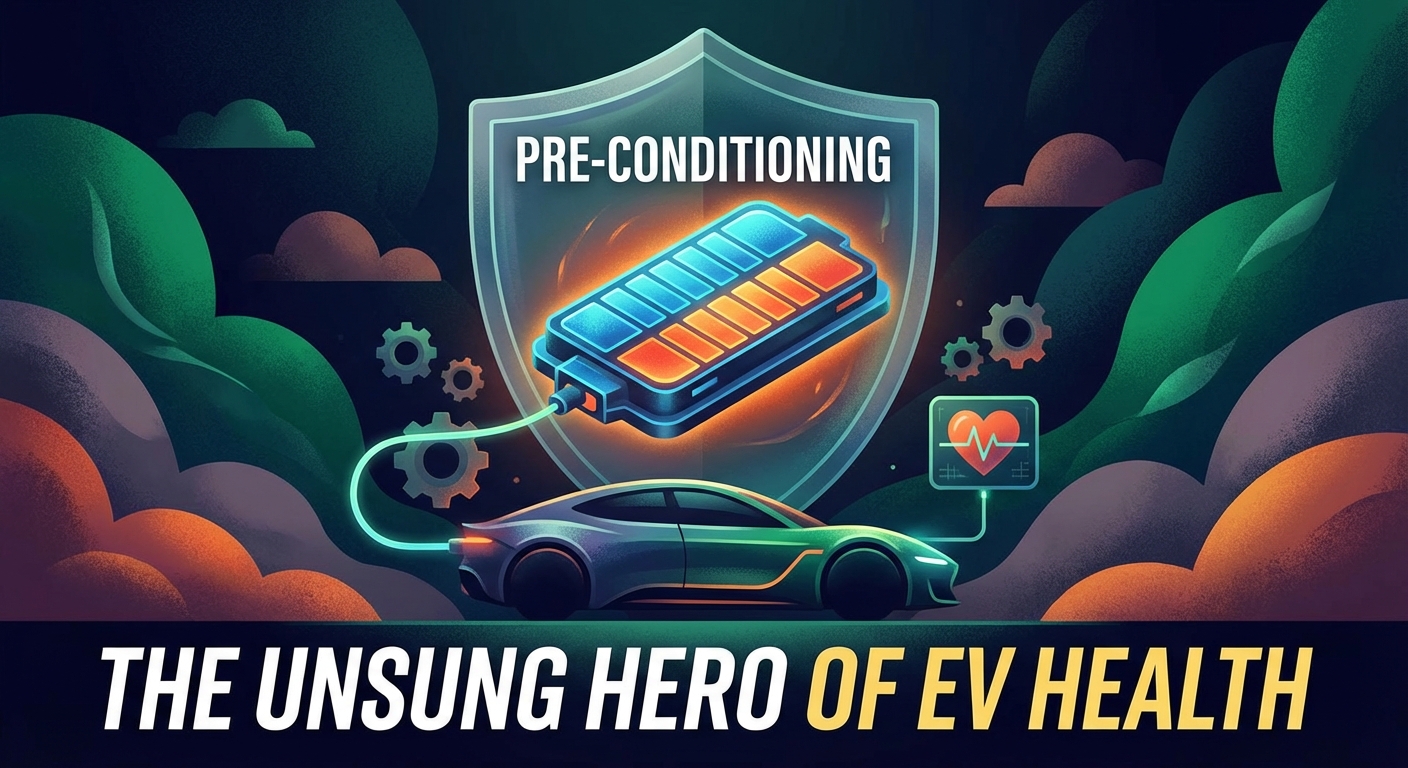
If the 20-80 rule is the star of the show, pre-conditioning is the best supporting actor.
Most people think pre-conditioning is just about comfort.
Sure, getting into a warm car in January or a cool car in July is amazing.
But from a mechanical standpoint, pre-conditioning is actually about protecting the battery.
Why Temperature Matters
Batteries are like humans. They hate being freezing cold, and they hate being boiling hot.
They operate best around 70°F (21°C).
When you drive a cold battery in the winter, the internal resistance is high.
This forces the car to work harder to push energy out. It puts immense strain on the internal components.
It also limits your regenerative braking, which reduces your efficiency.
Using Grid Power to Save Battery Power
Here is the trick to pre-conditioning.
You schedule your departure time in your car’s app while the car is still plugged into your wall charger.
This tells the car: "Hey, we are leaving at 8:00 AM. Get the battery and the cabin to the perfect temperature."
Because the car is plugged in, it uses electricity from your house to warm up the battery pack.
It does not use the energy stored in the battery itself.
When you unplug to leave, your battery is already at the optimal operating temperature.
This means you get full range immediately.
It also means you aren't stressing a cold battery by demanding instant highway speeds.
I use this feature religiously in both winter and summer. It is arguably the easiest way to extend your range and battery life simultaneously.
When Should You Break the Rules?
I know what you’re thinking.
"I bought a car with 300 miles of range. Why should I only use 60% of it?"
That is a valid question.
You should absolutely break the 20-80 rule when life demands it.
The Road Trip Exception
If I am going on a long road trip, I charge to 100%.
The key is timing.
I set the car to hit 100% right before I leave.
The damage from 100% charge happens when the car sits at that level for days.
If you charge to 100% and immediately drive it off, the degradation is negligible.
So, for that weekend getaway? Fill it up.
The LFP Battery Exception
There is one major exception to the 20-80 rule that I need to mention.
It depends on your battery chemistry.
Most EVs use Nickel-Cobalt-Aluminum (NCA) or Nickel-Manganese-Cobalt (NMC) batteries. These follow the 20-80 rule.
However, some newer standard-range vehicles (like the base Tesla Model 3) use Lithium Iron Phosphate (LFP) batteries.
LFP batteries are different. They actually like to be charged to 100% regularly.
It helps calibrate their battery management system.
Check your owner's manual. If you have an LFP battery, charge to 100% once a week. If you have anything else, stick to 80%.
DC Fast Charging: Use Sparingly
We can't talk about battery life without mentioning DC Fast Charging (Supercharging).
These chargers are incredibly convenient.
However, they blast the battery with massive amounts of current.
This creates heat. Lots of it.
While the car has cooling systems to manage this, frequent fast charging accelerates degradation compared to slow Level 2 home charging.
Think of fast charging like fast food.
It’s great when you’re in a rush or traveling.
But if you eat it for every meal, your health will suffer.
I treat fast chargers as "trip-only" tools. For daily use, I stick to my slow home charger.
The Financial Impact of these Habits
Why does all of this matter?
Resale value.
As EVs become more common, the used market is going to get smarter.
Buyers will eventually have ways to scan the "State of Health" (SoH) of a battery before buying.
A five-year-old EV with 95% original battery capacity will be worth significantly more than one with 85% capacity.
By following the 20-80 rule and pre-conditioning, you are essentially protecting your investment.
You are keeping the heart of your car strong.
Final Thoughts
Owning an EV requires a slight shift in mindset.
We are used to filling a gas tank to full and running it until the light comes on.
EVs require a more "grazing" approach.
Plug it in when you get home. Stop at 80%. Pre-condition before you leave.
It sounds like a lot of steps, but once you set it up in your app, it becomes automatic.
You won't even think about it.
But five years from now, when your car still has the same range it did on day one, you’ll be glad you did.
Drive safe, and keep it charged (but not too charged)!