Stop Returns Before They Happen: How WebAR Turns Mobile Browsers into Buyers
We’ve all been there.
You’re scrolling through your favorite online store late at night. You see a lamp that looks perfect for your bedside table. The photos are crisp, the lighting is professional, and the description says "modern minimalist."
You click "Add to Cart." Two days later, the box arrives.
You tear it open, place the lamp on your table, and... it’s huge. It looks ridiculous. It clashes with the wall color.
Now comes the part we all hate: The Return.
For the customer, it’s a hassle. For the merchant, it’s a profit-killer.
As the editor here at My Core Pick, I look at a lot of e-commerce trends. But few technologies have impressed me as much as Web-based Augmented Reality, or WebAR.
It isn't just a shiny new toy. It is a fundamental shift in how we shop on our phones.
Here is why WebAR is the secret weapon to stopping returns before they ever happen.
The "Imagination Gap" is Costing You Money

Let’s be honest about the state of e-commerce.
Online shopping has always had one major flaw compared to retail: you can’t touch the product.
You can’t see the scale. You can’t see how the texture interacts with the light in your specific room.
We rely on 2D images to make 3D decisions.
I call this the "Imagination Gap."
When a customer looks at a photo, they have to mentally project that object into their reality.
Humans are actually pretty bad at this. We overestimate space and underestimate size constantly.
The High Cost of Being Wrong
When the customer's imagination doesn't match reality, the product comes back.
Return rates for e-commerce hover anywhere between 20% and 30%. That is triple the rate of brick-and-mortar stores.
Every return eats into your margin. You pay for shipping (often both ways). You pay for restocking. You risk damage to the item.
But there is a bigger cost: Customer Loyalty.
If I have to return a couch because it didn't fit, I am annoyed. I might not shop with you again because I don't trust my own judgment on your site.
We need a way to close that gap. We need to give customers the truth.
Enter WebAR: The Frictionless Solution
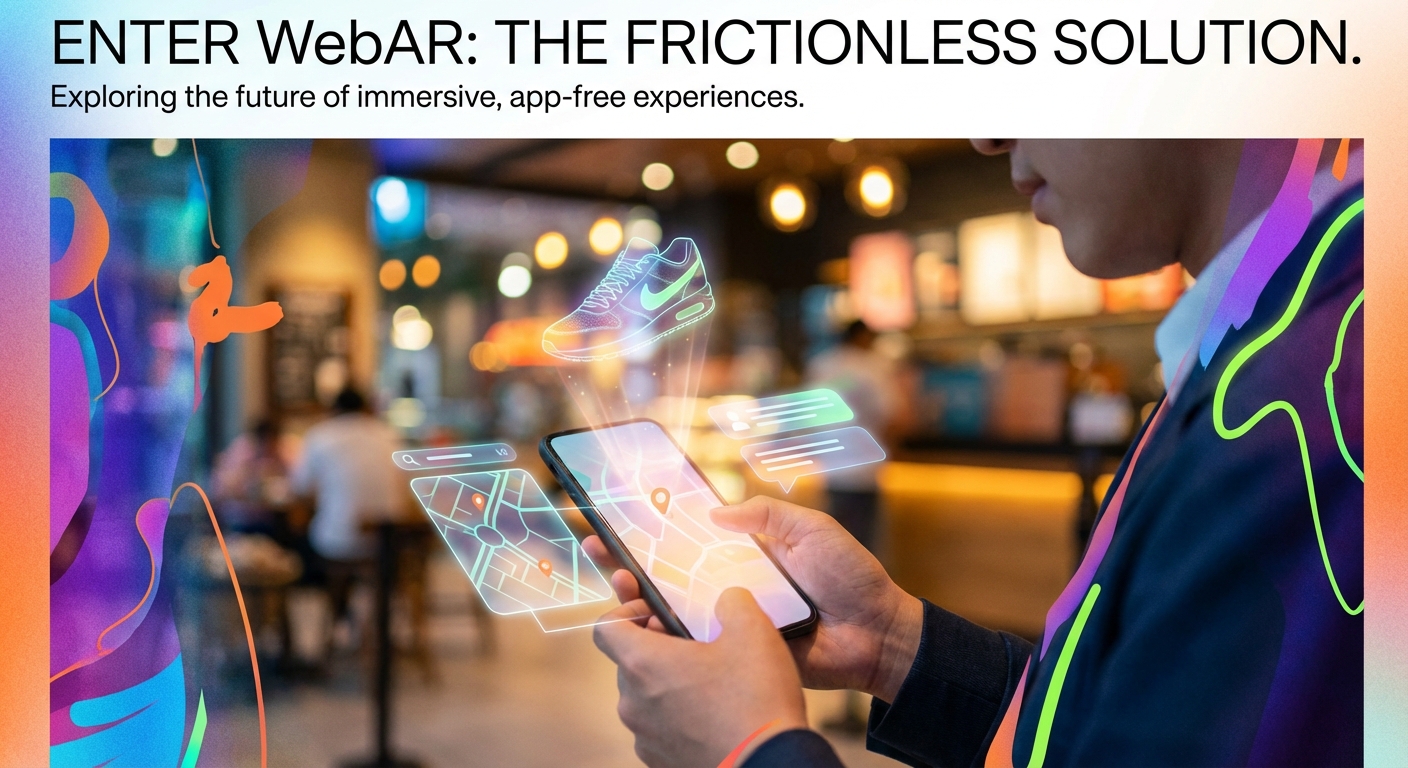
Augmented Reality (AR) has been around for a while.
Remember when everyone was catching Pokémon in the park? That was AR.
But for a long time, retailers got it wrong.
They buried AR features inside massive, clunky mobile apps.
If I want to buy a pair of sneakers, I do not want to download your 200MB app just to try them on.
That is too much friction. I’ll just guess the size or leave the site.
Why "Web" AR Changes Everything
This is where WebAR changes the game.
"Web" means it happens right in the browser (Chrome, Safari, etc.).
There is no app store. No download bars. No passwords to remember.
The customer simply clicks a button that says "View in My Space" or "Try On."
Suddenly, the camera opens, and the product is right there in the room.
It creates a seamless flow from browsing to experiencing.
We have seen that when you remove the friction of an app download, engagement rates skyrocket.
The Psychology of Ownership
There is a psychological phenomenon known as the "Endowment Effect."
Basically, humans value things more highly once they feel like they own them.
In a physical store, picking up an item triggers this.
In e-commerce, WebAR is the closest we get to that feeling.
Visualizing is Believing
When I place a virtual coffee table in my actual living room, something shifts in my brain.
I’m no longer looking at a product on a white background. I am looking at my living room with a new addition.
I can walk around it. I can get close to see the texture. I can see if it blocks the walkway.
By the time I hit the "Buy" button, I feel like I’ve already made the decision.
The item is already "mine" in a digital sense.
Building Confidence
Confidence is the currency of e-commerce.
Uncertainty creates cart abandonment. If I’m 90% sure, I might buy. If I’m 60% sure, I’ll wait.
WebAR pushes that percentage up to 99%.
When a customer knows exactly how a shade of lipstick looks on their skin tone, or exactly how much space a desk takes up, they buy with confidence.
Confident buyers don’t return items.
Who Is Doing It Right?
You might think this is only for massive tech giants.
While big brands paved the way, the tech is accessible to everyone now.
Here are the sectors seeing the biggest drop in returns thanks to WebAR.
Furniture and Home Decor
This is the "killer app" for AR.
I recently bought a rug online. The site let me project the rug onto my floor.
I realized instantly that the 5x7 size was too small. I sized up to an 8x10.
If I hadn't used WebAR, I would have ordered the 5x7, hated it, and sent it back.
That store saved a return and made a larger sale.
Footwear and Fashion
Virtual Try-On (VTO) is exploding.
Using the front-facing camera, WebAR can map a pair of sunglasses to your face.
It can track your feet to show you how those limited-edition sneakers look on you.
It can even show the drape of a watch on your wrist.
We are seeing a massive reduction in "bracketing."
What is Bracketing?
Bracketing is when a customer buys the same shirt in Medium, Large, and XL, intending to return two of them.
It is a nightmare for inventory management.
With WebAR sizing tools, customers can see the fit before they buy, effectively killing the need to bracket.
The Sustainability Angle
I want to touch on something that is becoming very important to modern consumers: Sustainability.
Returns are terrible for the planet.
The carbon footprint of shipping returns back and forth is massive.
Billions of pounds of returned goods end up in landfills every year because it is cheaper to trash them than to restock them.
Promoting Eco-Friendly Shopping
By implementing WebAR, you aren't just saving money.
You are actively reducing your carbon footprint.
We are seeing brands use this in their marketing. "Measure twice, buy once, save the planet."
It resonates with Gen Z and Millennial shoppers.
They want to know that the brand cares. Helping them make the right choice the first time shows you respect their time and the environment.
Implementing WebAR: Easier Than You Think
If you are a store owner reading this, you might be intimidated.
You might be thinking, "I can't afford 3D modeling."
Two years ago, you might have been right. Today, it is much different.
The Tech Stack
The technology has standardized.
Apple uses a file format called USDZ. Android uses glTF.
Most modern WebAR platforms handle the conversion automatically.
You just need a 3D model of your product.
There are now AI scanning tools where you can take a video of your product with your phone, and it generates a 3D model for you.
Integration is Key
Platforms like Shopify, WooCommerce, and BigCommerce have native support for this now.
It often involves just uploading the 3D file alongside your JPEG images.
The browser handles the rest.
If you have a catalog of 1,000 items, start small.
Pick your top 10 best-sellers. Or, pick your top 10 "most returned" items.
Create 3D models for those. Test the results.
I guarantee you will see a difference in the return metrics for those specific SKUs.
Summary: The Future is Immersive
We are moving away from the flat internet.
The static grid of images served us well for twenty years, but we have hit the ceiling of what it can do.
WebAR is the bridge to the next generation of commerce.
It turns the mobile browser into a fitting room and a showroom.
It empowers the customer to become their own interior designer or stylist.
Most importantly, it aligns expectations with reality.
When the customer opens the box, they smile. They don't frown.
They got exactly what they saw in their living room.
That is how you stop returns. Not with stricter policies, but with better technology.
If you haven't looked into WebAR for your shop yet, now is the time.
Don't wait for your competitors to normalize it. be the one who sets the standard.