There is a specific kind of heartbreak that happens at 6:30 AM.
You buy the expensive beans. You use filtered water. You weigh everything out on a digital scale like a chemist.
The aroma fills the kitchen, and you’re ready for nirvana.
Then, you take the first sip.
And your face involuntarily twists up.
Maybe it’s sharp and grassy, hitting the sides of your tongue like biting into a lemon peel. Or maybe it’s harsh, hollow, and tastes like burnt toast and medicine.
Here at My Core Pick, we see this happen all the time.
Most people blame the beans. They assume they bought a "bad roast."
Others blame their coffee maker, assuming they need a $300 upgrade to fix the problem.
But 90% of the time, the culprit is much simpler. It’s free to fix, and it’s right at your fingertips.
It’s your grind size.
Understanding the difference between sour and bitter—and how to adjust your grinder to fix it—is the single most important skill in home brewing.
Here is the simple guide to saving your morning cup.
The Golden Rule: It’s All About Extraction

Before we start twisting dials on the grinder, we need to understand what is actually happening inside your brewer.
Coffee brewing is just extraction. You are using hot water to dissolve flavor compounds from ground beans.
But those compounds don’t all come out at the same time.
It happens in a specific order.
First, the acids and fats release. These provide the bright, fruity notes.
Next come the sugars. This provides the sweetness and the body.
Finally, the heavy plant fibers break down. These are the bitter, dry tannins.
Your goal is to stop the water right in the middle. You want the acids and the sugars, but you want to stop before the heavy bitterness kicks in.
This is the "Sweet Spot."
Grind size is the traffic controller that determines how fast this happens.
If your grind is too coarse, water rushes through too fast. You don’t get enough flavor.
If your grind is too fine, water gets stuck. You pull out way too much flavor (and the bad stuff, too).
The Sour Trap: When to Grind Finer
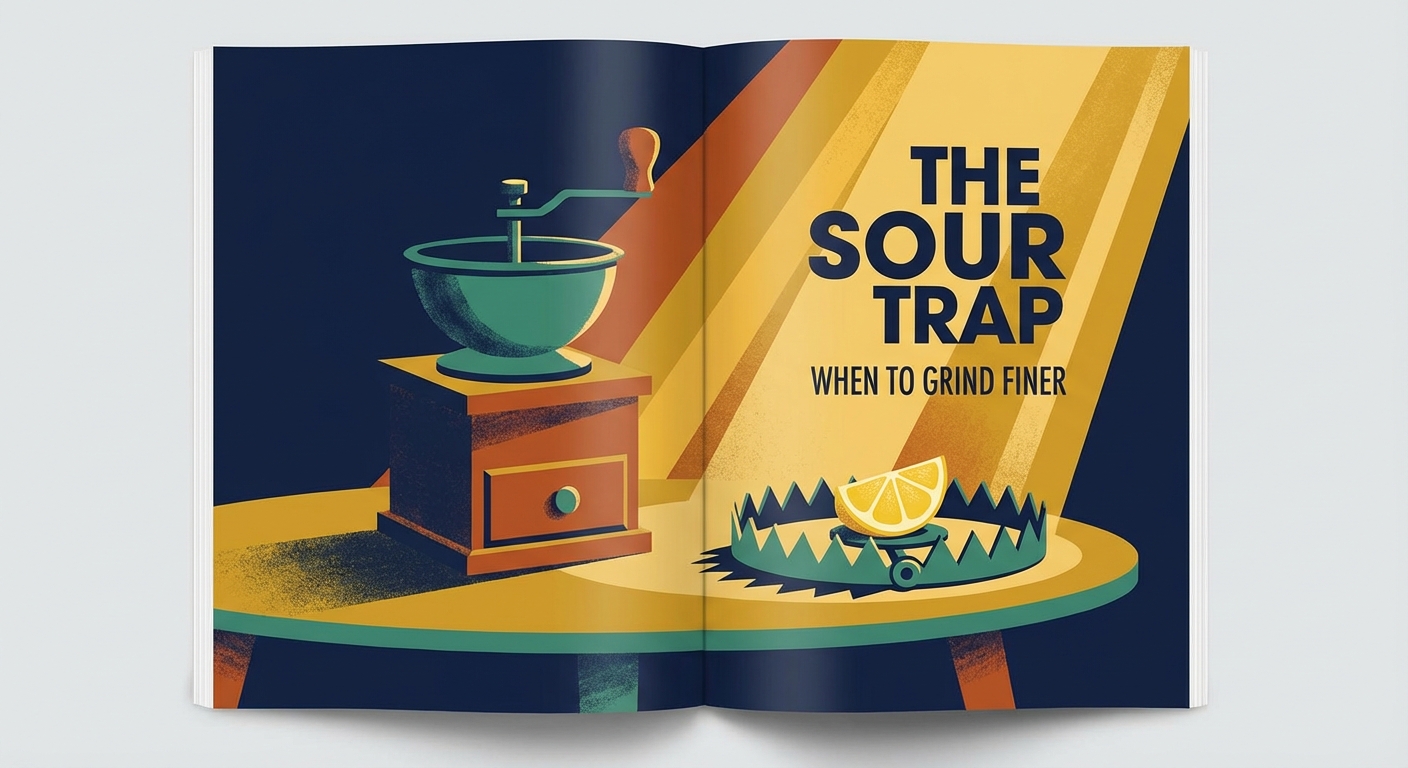
Let’s talk about the first enemy of good coffee: Sourness.
In the coffee world, we call this Under-extraction.
It means the water didn’t spend enough time with the coffee grounds. It grabbed the initial acids, but it rushed past the sugars.
How to Identify It
It’s important to distinguish between "acidity" (which is good) and "sourness" (which is bad).
Good acidity tastes like a ripe strawberry or a crisp apple. It’s pleasant.
Bad sourness makes your lips pucker.
It tastes grassy.
It can sometimes taste salty.
It has a thin, watery mouthfeel that disappears quickly.
If you take a sip and immediately feel a sharp, biting sensation on the sides of your tongue, your coffee is under-extracted.
The Fix: Go Finer
Imagine you have a jar filled with boulders. If you pour water over them, the water falls right to the bottom instantly.
That is your coarse coffee grounds.
To fix sour coffee, you need to slow the water down. You need to increase the surface area of the coffee.
You do this by adjusting your grinder to a finer setting.
Move the dial a notch or two toward "Fine."
The particles become smaller. They pack together tighter.
The water has to work harder to get through. This extra time allows the water to pull out those missing sugars.
Suddenly, that sharp lemon taste transforms into a balanced, sweet cup.
The Bitter End: When to Grind Coarser
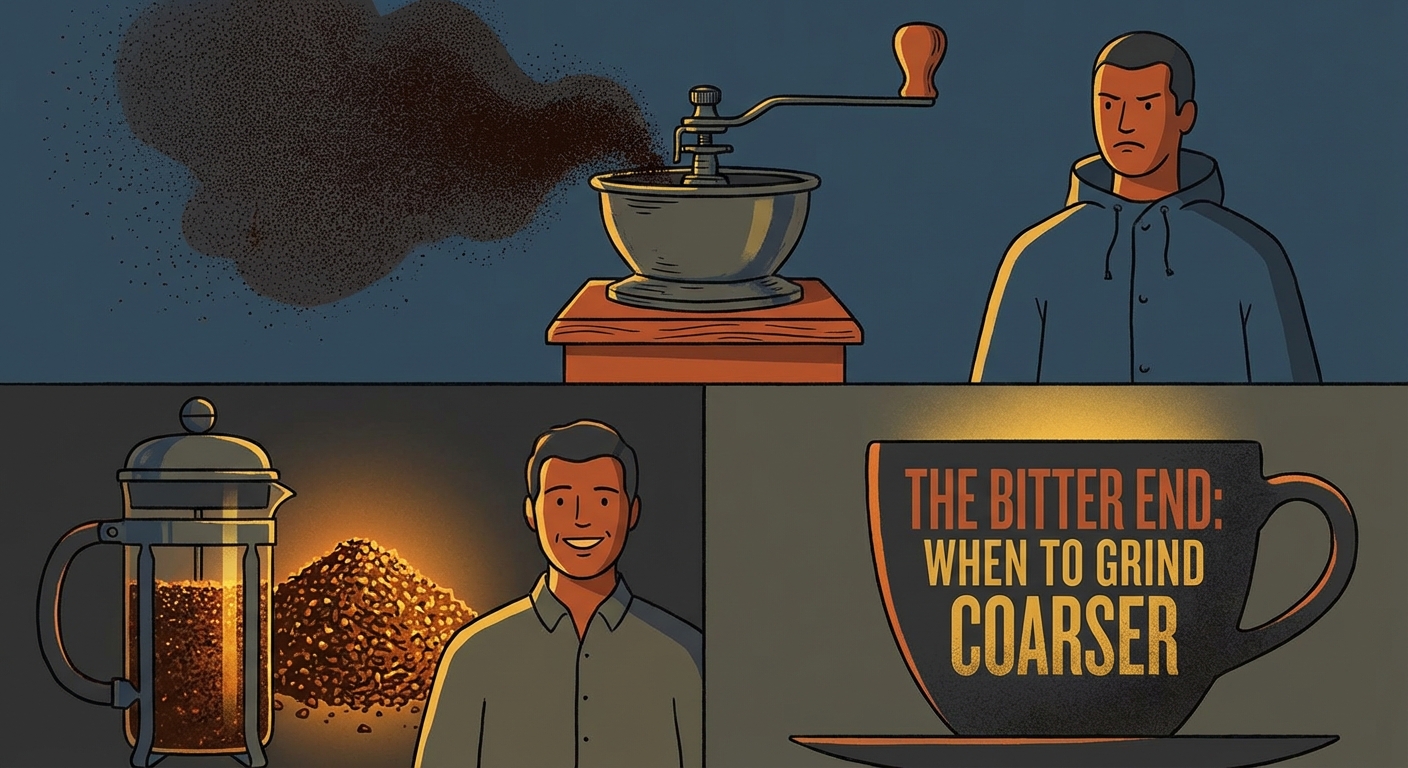
Now for the second enemy: Bitterness.
We call this Over-extraction.
This happens when the water spends too much time hanging out with the coffee grounds.
It dissolved the acids. It got the sugars. But then it kept going.
It started breaking down the cellulose and plant fibers that you don’t want to taste.
How to Identify It
Bitter coffee is harsh.
It tastes like aspirin or burnt rubber.
It masks all the unique flavors of the bean. A light roast will taste like a dark roast if it is over-extracted.
But the biggest tell isn't just taste; it's physical sensation.
Over-extracted coffee is astringent.
It creates a drying sensation on your tongue, similar to drinking a cheap red wine or unsweetened black tea.
If you take a sip and feel like you need a glass of water to wash your mouth out, you’ve over-extracted.
The Fix: Go Coarser
Let’s go back to the jar analogy. Instead of boulders, imagine the jar is full of sand.
If you pour water on top, it pools. It takes a long time to seep through to the bottom.
This is your fine coffee grounds.
To fix bitter coffee, you need to speed the water up.
You do this by adjusting your grinder to a coarser setting.
Open up the burrs. Make the particles larger, like sea salt rather than table salt.
The water will flow through the bed of coffee faster.
It will grab the good stuff and exit the brewer before it starts pulling out the dry, bitter tannins.
The "My Core Pick" Grind Spectrum
Context is everything.
A "Fine" grind for a French Press is totally different from a "Fine" grind for an espresso machine.
To help you dial in, here is a quick visualization of what your grounds should look like for the most common brew methods.
Extra Coarse (Cold Brew)
Texture: Peppercorns or Rock Salt.
Why: Cold brew sits in water for 12 to 24 hours. If you grind fine, it will taste like mud. You need massive chunks to slow extraction down over a full day.
Coarse (French Press)
Texture: Sea Salt.
Why: The coffee is immersed in hot water for 4 minutes. You need chunky grounds so they don't dissolve too fast, and so they get caught by the metal mesh filter.
Medium (Automatic Drip)
Texture: Sand.
Why: This is the standard. It provides enough resistance for the gravity-fed water to extract sweetness without clogging the paper filter.
Medium-Fine (Pour Over / V60)
Texture: Table Salt.
Why: Because you are pouring by hand, you have more control. A slightly finer grind helps clarify complex flavors, but it requires a steady pouring hand.
Fine (Espresso)
Texture: Powdered Sugar or Flour.
Why: You are using 9 bars of pressure to force water through a puck in 30 seconds. You need maximum surface area and resistance to create that rich crema.
How to Dial It In: A Step-by-Step Protocol
You know the theory. Now, let’s apply it to your kitchen routine.
The next time you brew a cup, don’t just drink it mindlessly. Use this three-step protocol to perfect your recipe.
Step 1: Lock in Your Ratio
Consistency is key. You cannot fix your grind if you keep changing how much coffee and water you use.
Pick a ratio. We recommend 1:16 (1 gram of coffee for every 16 grams of water).
Stick to this every single day.
Keep your water temperature the same, too (around 200°F or 93°C).
By locking these variables, the only thing changing is the grind size.
Step 2: The Taste Test
Brew your coffee. Let it cool slightly (hot coffee hides flavors).
Take a sip and ask yourself one question:
Is it sharp, or is it drying?
Don’t overcomplicate it with "notes of blueberry." Just look for the defect.
If it’s sharp/sour: Your grind was too coarse.
If it’s drying/bitter: Your grind was too fine.
Step 3: The Micro-Adjustment
This is where people mess up. They make huge swings on the dial.
If your coffee was sour, move your grinder one notch finer. Just one.
If you have a stepless grinder, move it a few millimeters.
Brew again the next morning.
Did it get better? Great. You are moving in the right direction.
Is it still a little sour? Go one more notch finer.
Eventually, you will go too far, and it will taste bitter. That’s okay!
Just back it off one notch coarser.
Congratulations. You have found the sweet spot.
A Note on Grinders (Blade vs. Burr)
We have to address the elephant in the room.
If you are reading this and thinking, "I use a blade grinder with a spinning metal propellor," we have some tough news.
You cannot fix sour or bitter coffee with a blade grinder.
Blade grinders chop beans unevenly. You end up with "boulders" (sour) and "dust" (bitter) in the same basket.
You will taste sour and bitter simultaneously. It is a confusing, muddy mess.
To use the strategy in this article, you need a Burr Grinder.
It uses two abrasive surfaces to crush the beans into uniform sizes.
If you want to upgrade your morning routine, skip the fancy coffee maker. Buy a decent burr grinder instead. It is the single best investment you can make.
The Takeaway
Coffee is personal. Some people love a bright, acidic cup. Others prefer a deep, dark punch.
But nobody likes sourness, and nobody likes astringency.
The next time your morning cup disappoints you, don't pour it down the sink in frustration.
Analyze it.
If it puckers your lips, tighten the grind.
If it dries your tongue, loosen the grind.
It really is that simple.
Mastering this adjustment doesn't just save your morning coffee; it turns you from a caffeine consumer into a home barista.
Happy brewing!