Here is the blog post drafted specifically for My Core Pick.
Automating the Boring Stuff: A Guide to Cobots for Small-Batch Manufacturing
If there is one thing I’ve learned running My Core Pick, it’s that efficiency isn’t just about speed.
It’s about sanity.
I talk to small business owners and shop managers every week. They all tell me the same story. They have brilliant machinists and talented craftsmen on the payroll.
But those talented people are spending half their day loading CNC machines. Or folding cardboard boxes. Or sanding the same curved part for four hours straight.
It’s a waste of talent. It kills morale. And frankly, it’s boring.
For a long time, automation was only for the big guys. If you were Ford or Toyota, you bought massive industrial robots. You put them in cages. You hired an expensive engineer to code them.
But if you run a high-mix, low-volume shop? You were out of luck.
That has changed. Enter the Cobot (Collaborative Robot).
Today, I’m going to walk you through why I believe cobots are the single best investment for small-batch manufacturing. We are going to look at how to automate the boring stuff so your team can focus on the brilliant stuff.
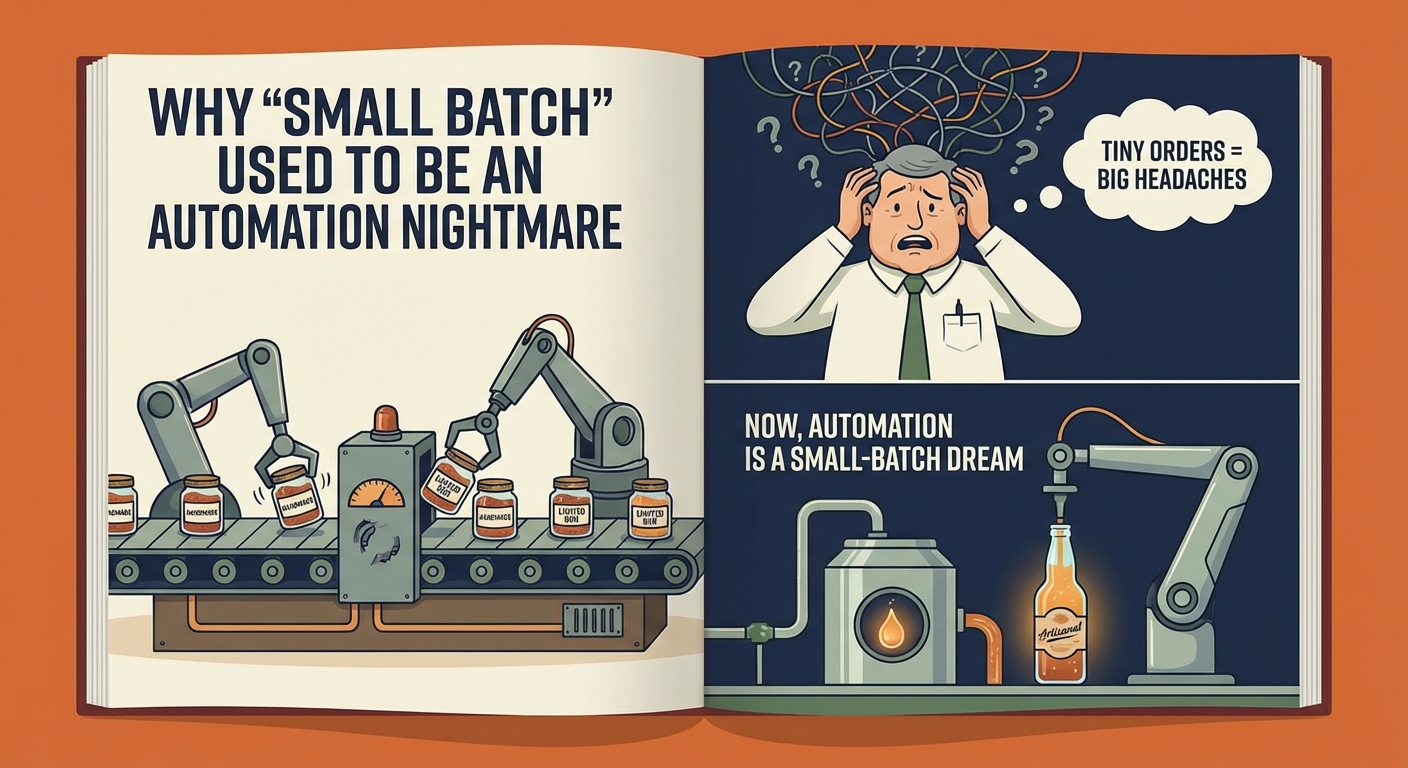
Why "Small Batch" Used to Be an Automation Nightmare
Let’s be real about the history of manufacturing.
Traditional industrial robots are incredible, but they are rigid.
They are designed to do the exact same thing, millions of times, without stopping.
The "High-Mix" Problem
In a small shop, you might run 500 parts on Tuesday and a completely different 200 parts on Wednesday.
Re-programming a traditional industrial robot for that switch could take days. It just wasn’t worth the downtime.
You needed flexibility, and the only thing flexible enough was a human.
The Cost Barrier
Then there was the price tag.
By the time you paid for the robot, the safety cage, the light curtains, and the integration specialist, you were looking at a quarter-million dollars.
For a small business, that is a terrifying ROI timeline.
This is why cobots have disrupted the industry. They bridge the gap between manual labor and full industrial automation.
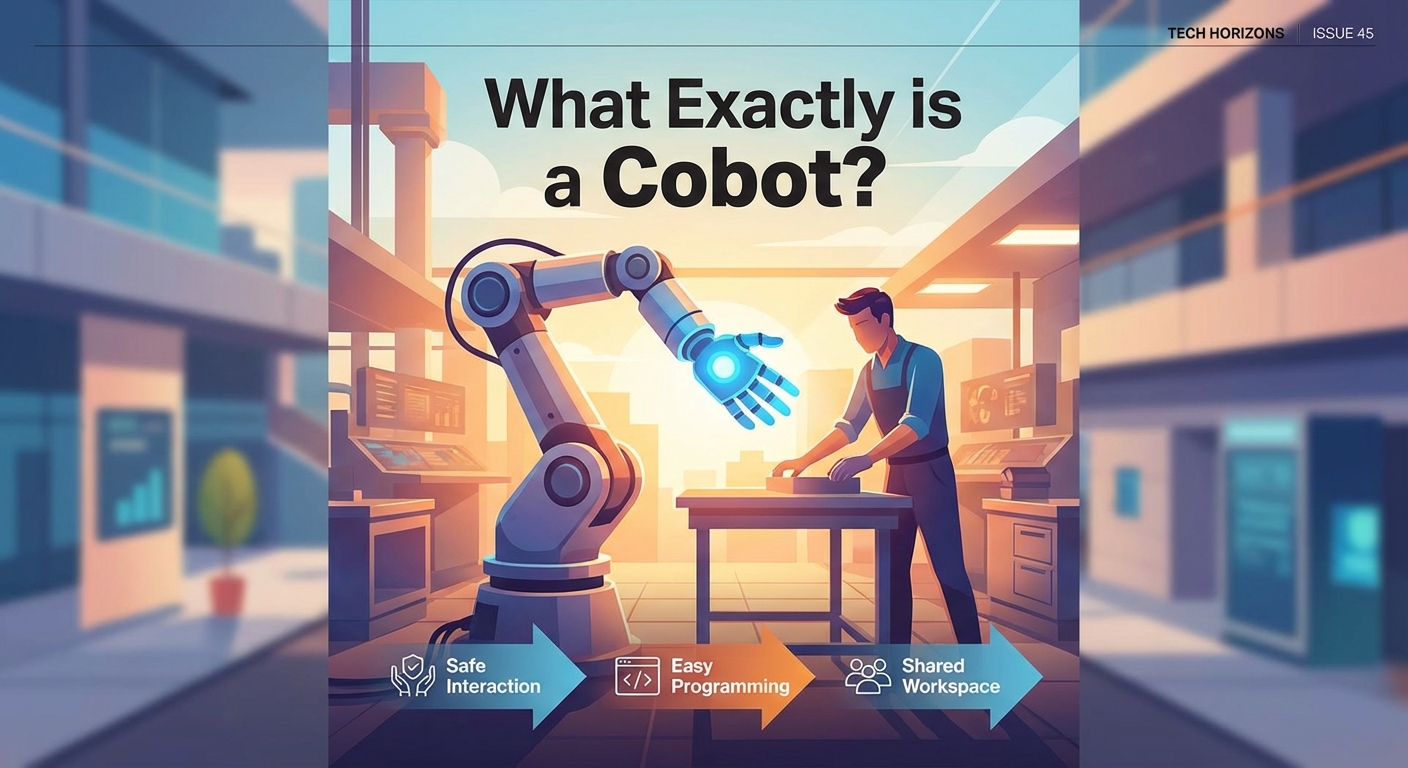
What Exactly is a Cobot?
I get asked this a lot. "Is it just a small robot?"
Not exactly.
A Cobot, or Collaborative Robot, is designed to work alongside humans, not replace them.
They are the teammates you didn’t know you needed.
Safety First
The defining feature of a cobot is safety.
Traditional robots are dangerous. If you walk into their swing path, they won't stop. That is why they live in cages.
Cobots are different. They use force-limiting sensors and advanced torque monitoring.
If a cobot bumps into you, it stops immediately. It feels the resistance and freezes.
This means you don’t need a cage. You can mount a cobot right next to your CNC operator. They can hand parts back and forth.
Ease of Programming
This is my favorite part.
I am not a coder. Most shop owners aren’t Python experts.
Cobots are designed for us. Most of them utilize "lead-through" teaching.
You literally grab the robot arm, move it to where you want it to go, and hit "Save Point" on a tablet.
It is intuitive. It feels like teaching a new employee, rather than programming a machine.
Top Use Cases: Banish the Monotony

So, what should you actually automate?
At My Core Pick, we believe in the "3 D's" of automation: Dull, Dirty, and Dangerous.
If a task fits those descriptions, give it to the cobot.
Here are the best applications I’ve seen for small-batch shops.
Machine Tending
This is the "gateway drug" of cobot automation.
You have a CNC mill or lathe. A human operator has to stand there, open the door, take a part out, blow off the chips, put a new part in, and press the green button.
It is mind-numbing work.
A cobot can do this all day long. It never calls in sick. It never gets bored.
Your operator can set up the raw materials and then go do quality control or setup the next job while the cobot tends the machine.
Sanding and Polishing
I hate sanding. Everyone hates sanding.
It is dusty. It causes repetitive strain injuries (RSI). It is loud.
Cobots are fantastic at this. Because they have force sensors, they can apply consistent pressure across a curved surface.
A human gets tired after two hours. Their pressure becomes uneven. The finish quality drops.
A cobot applies the exact same pressure at 8:00 AM as it does at 4:00 PM. The consistency is unbeatable.
Pick and Place / Packaging
At the end of the line, someone has to put the product in the box.
It is a low-value task, but it has to be done.
Cobots equipped with vacuum grippers can palletize boxes or load trays faster and more accurately than a human.
This frees up your team to handle logistics or customer service.
The Financials: Understanding ROI
Let’s talk money.
I know margins are tight in small manufacturing.
When you look at the price of a cobot arm (usually between $25k and $45k), it can feel steep.
But you have to look at the Total Cost of Ownership (TCO) versus the value.
The Labor Multiplier
Don't think of a cobot as replacing a worker.
Think of it as cloning your best worker’s hands.
If you pay a skilled machinist $30/hour, you want them solving problems and programming toolpaths. You don't want them loading slugs into a vice.
If a cobot frees up 50% of that machinist's time, the robot pays for itself in less than a year.
Consistency is Cash
There is also the hidden cost of scrap.
Humans make mistakes when they are tired. We drop parts. We misalign jigs.
Cobots offer repeatability within 0.1mm or better.
Reducing your scrap rate by even a small percentage adds up directly to your bottom line.
Retaining Talent
We are in the middle of a massive labor shortage in manufacturing.
Young people don’t want to do "dull" factory jobs.
By bringing in cobots, you modernize your shop. You tell your employees, "I value your brain, not just your muscles."
That creates a culture that retains top talent.
Getting Started: A Step-by-Step Guide
Okay, you are interested. You want to automate the boring stuff.
Where do you start?
Here is the roadmap I recommend to everyone who asks me for advice.
1. Start Small and Simple
Do not try to automate your most complex task first.
I see this mistake all the time. People try to automate a task that requires complex vision systems and AI bin-picking.
They get frustrated and give up.
Start with a simple "Pick and Place" or a basic machine tending operation. Get an early win. Build confidence.
2. Choose the Right End-Effector
The robot arm is just the delivery system. The business happens at the wrist.
This is called the "End-Effector" or gripper.
For variable parts, look at adaptive grippers (like 2-finger or 3-finger claws).
For flat surfaces or boxes, vacuum grippers are king.
Spend time researching the right tool for the job. It matters more than the arm itself.
3. Involve Your Team
This is crucial.
If you just drop a robot on the shop floor one day, your staff will get nervous. They will think they are being replaced.
Involve them in the process early. Ask them, "What is the most annoying part of your day?"
When they tell you, say, "Great, let's get a robot to do that for you."
Make them the robot operators. Give them ownership of the automation.
Suddenly, the robot isn't a threat. It's a tool that makes their life easier.
The Future of Your Shop
I truly believe we are in a golden age for small manufacturing.
Technology that used to be exclusive to the automotive giants is now sitting on a workbench in a garage shop.
Cobots are leveling the playing field.
They allow a five-person shop to compete with a fifty-person factory.
They allow you to run a "Lights Out" shift, where the robot keeps working after everyone has gone home for dinner.
That isn't just efficiency. That is freedom.
So, take a look around your shop today. Look for the boring stuff. Look for the tasks that make your shoulders slump.
That is where you start.
If you are ready to dive deeper into specific models or gripper setups, keep exploring My Core Pick. We are here to help you filter through the noise and find the gear that actually works.
Let’s get those robots working, so we can get back to creating.