It’s 3:00 AM. You are staring at the ceiling.
Your mind is racing through a slideshow of potential disasters.
Maybe it’s a project at work that isn’t going quite right. Maybe it’s a text message someone hasn't replied to yet.
Or maybe it’s the state of the global economy, the traffic you’ll face tomorrow, or the opinion of a stranger on the internet.
We have all been there.
We live in an age of information overload. Because we know everything that is happening, we feel a subconscious pressure to control everything that is happening.
But here is the hard truth.
Most of the stress you feel isn't coming from the chaos itself.
It is coming from your desperate attempt to tame it.
We exhaust ourselves trying to bend the world to our will. We try to script the future. We try to micro-manage the perceptions of others.
It’s a losing battle.
But there is a better way. It’s an ancient operating system for the mind that is more relevant today than ever before.
It’s called Stoicism.
And it starts with learning the art of letting go.
The Illusion of the Driver’s Seat

We like to think we are the pilots of our lives.
To an extent, we are. We steer our choices, our values, and our actions.
But somewhere along the line, we confused being the pilot with being the weather controller.
We think that if we just worry hard enough, we can prevent rain.
The Anxiety Loop
When we try to control things that are inherently uncontrollable, we enter the Anxiety Loop.
First, we identify a variable (like what our boss thinks of us).
Next, we realize we can’t force an outcome.
Then, instead of accepting that, we double down. We over-analyze. We ruminate. We stress.
This doesn't change the outcome.
It only robs us of our energy in the present moment.
The Cost of Clinging
The cost of this control freak tendency is high.
It leads to burnout. It damages relationships because people don’t like being managed.
Most importantly, it destroys our peace of mind.
You cannot be peaceful while you are at war with reality.
The Stoic Golden Rule: The Dichotomy of Control
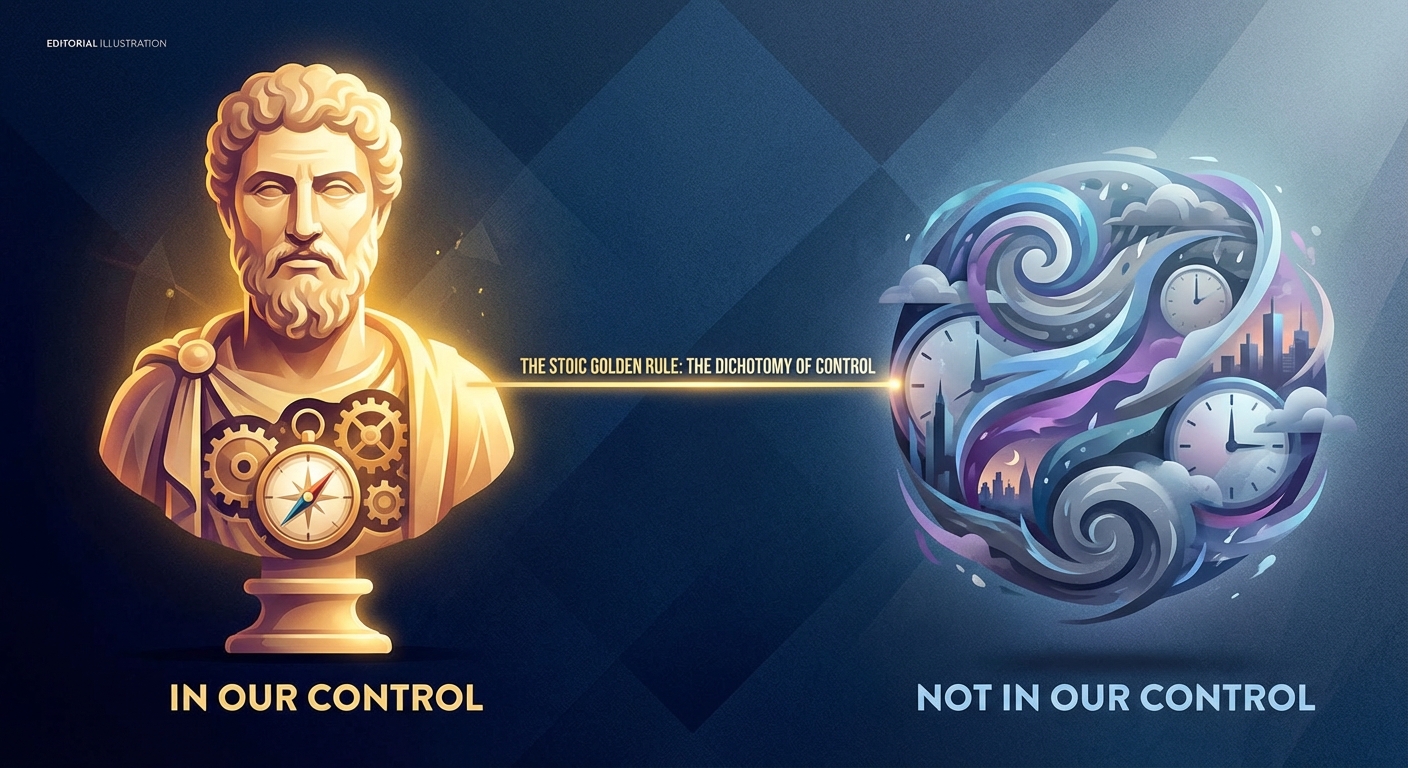
Two thousand years ago, a former slave turned philosopher named Epictetus laid down the foundation of Stoic peace.
He called it the "Dichotomy of Control."
It is deceptively simple.
Epictetus said, "Some things are up to us, and some things are not up to us."
That’s it. That is the whole secret.
But let’s break down what that actually means for us in the 21st century.
What Is Up To Us (The Internal)
According to the Stoics, the list of things we control is actually very short.
We control our judgments.
We control our intentions.
We control our effort.
We control our own character and how we choose to react to a situation.
This is your fortress. This is where you have total agency.
What Is Not Up To Us (The External)
Here is the list of things we do not have total control over.
Our bodies (we can get sick despite healthy habits).
Our property (it can be stolen or destroyed).
Our reputation (people can misunderstand us).
The past. The future. The economy. The weather. The traffic.
And crucial to remember: Other people.
When we try to drag items from the second list into the first list, we suffer.
Every single time.
Applying Ancient Wisdom to Modern Chaos
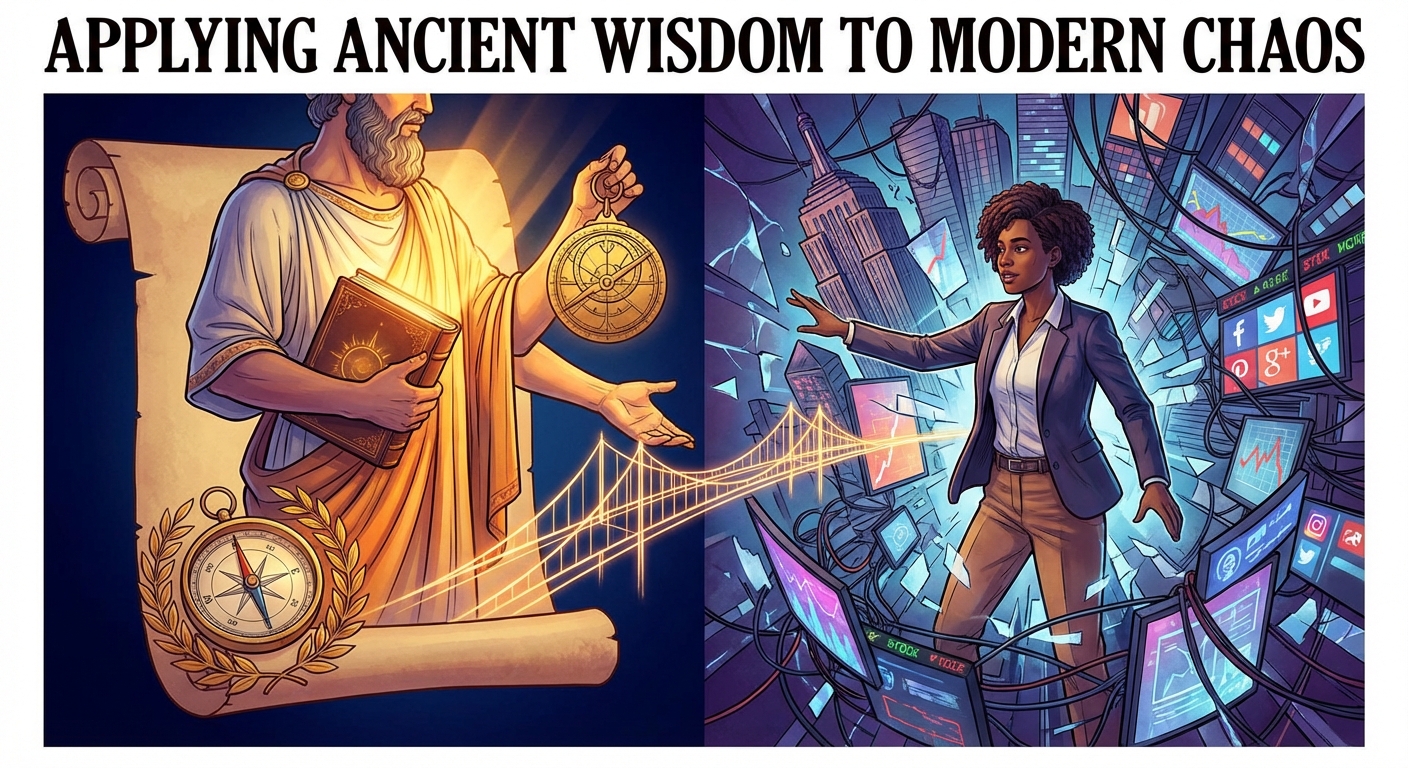
Philosophy is useless if it’s just words on a page.
We need to apply this to the gritty, annoying reality of modern life.
Let’s look at three common scenarios where our control issues flare up, and how a Stoic shift can bring peace.
Scenario 1: The Traffic Jam
You are late for a meeting. Traffic comes to a dead halt.
The Control Mindset: You grip the steering wheel. You curse the other drivers. You weave lanes. You visualize being fired. You arrive sweaty, angry, and flushed.
The Stoic Mindset: You realize you cannot clear the road. That is "not up to you."
What is up to you?
You can call ahead to say you’ll be late.
You can use the time to listen to a podcast or breathe.
You can accept that you are where you are.
The traffic is the same in both scenarios. But in the second one, you haven't poisoned your own blood with cortisol.
Scenario 2: Social Media Validation
You post a photo or an article. You check your phone five minutes later.
No likes. Or worse, a negative comment.
The Control Mindset: You spiral. You delete the post. You argue with the stranger in the comments. You let it ruin your dinner.
The Stoic Mindset: You realize that your effort in creating the post was up to you.
How people receive it is not up to you.
You cannot control the algorithm or the mood of a stranger.
You detach your self-worth from the metric. You put the phone down.
Scenario 3: The Archer’s Paradox
The Stoics loved the analogy of the archer.
An archer can choose the best bow. He can maintain the string. He can train for years.
He can aim with perfect precision.
But the moment the arrow leaves the bow, it is no longer up to him.
A gust of wind could blow. The target could move.
If the archer ties his happiness only to hitting the bullseye, he is fragile.
If he ties his happiness to shooting well, he is invincible.
In your career, focus on shooting well. The result will take care of itself.
Amor Fati: Learning to Love the Chaos
Once you stop trying to control everything, you can take the next step.
It isn't just about "tolerating" the chaos.
It is about embracing it.
Nietzsche, heavily influenced by the Stoics, coined the term Amor Fati.
It translates to "Love of Fate."
The Fire That Consumes
Marcus Aurelius, the Roman Emperor and Stoic philosopher, wrote about this beautifully.
He said that a fire turns everything you throw into it into flame and brightness.
If you throw a small obstacle into a small fire, it might snuff it out.
But if your inner fire is strong, obstacles become fuel.
Turning Obstacles into the Way
When things go "wrong," we usually panic.
The Stoic looks at a disaster and asks, "How can I use this?"
You didn't get the promotion? Good. Now you have time to develop new skills or look for a company that values you.
Flight cancelled? Good. You have five hours to read that book you’ve been putting off.
We don't passively accept the bad stuff.
We actively repurpose it.
We stop screaming at the rain and start collecting the water.
A 3-Step Guide to Letting Go
How do we actually practice this?
We can’t just flip a switch and become a Zen master.
It takes training.
Here is a simple three-step process I use when I feel the urge to control rising up.
Step 1: The Pause
When anxiety hits, stop.
Literally freeze.
Don't send the text. Don't honk the horn. Don't send the angry email.
Buy yourself 60 seconds of silence.
Victor Frankl said that between stimulus and response, there is a space. In that space lies our freedom.
Find the space.
Step 2: The Bucket Test
Visualize two buckets.
Bucket A: Up to Me.
Bucket B: Not Up to Me.
Look at your problem. Break it into pieces.
Throw the pieces into the respective buckets.
"My preparation for the presentation" goes in Bucket A.
"Whether the client is in a bad mood" goes in Bucket B.
Be ruthless with this sorting process.
Step 3: The Pivot
Now, look only at Bucket A.
Pour all your energy, all your passion, and all your focus into that bucket.
Ignore Bucket B.
Leave it alone. It will do what it does regardless of your worry.
Trust that by maximizing Bucket A, you are giving yourself the best possible chance of a good outcome.
And if the outcome is still bad?
You know you did your part. You can sleep at night.
Finding Peace in the Eye of the Storm
Letting go of control is scary.
It feels like we are giving up.
But it is actually the ultimate act of power.
When you stop trying to control the world, the world loses its power over you.
You become unshakeable.
You realize that peace isn't found in a perfectly ordered life where nothing goes wrong.
Peace is found in the certainty that whatever goes wrong, you can handle it.
You can handle your reaction. You can handle your character.
The rest is just noise.
So tonight, if you find yourself staring at the ceiling again, remember the archer.
You have shot your arrow for the day.
Let it fly.
Let the wind blow how it will.
Rest easy knowing that the only thing you truly possess is your own mind, and that is enough.