Here is the blog post, written in your requested format and tone.
Stop Drowning in Tiny Tasks: How the 2-Minute Rule Will Save Your Sanity
You know the feeling.
It’s 10:00 AM. You sit down with a fresh cup of coffee, ready to tackle that big project.
But then, your phone buzzes. Just a quick text.
Then you notice a dirty mug on your desk from yesterday.
Then you remember you forgot to reply to that email from three days ago.
Suddenly, your brain feels like a browser with 50 tabs open.
You aren't tired because of physical labor. You are exhausted because of mental clutter.
At My Core Pick, we talk a lot about essentialism and finding the core of what matters.
But you can’t focus on the core when you are buried under a layer of dust.
That "dust" is the accumulation of tiny, insignificant tasks.
Today, I’m going to share the single most effective strategy I’ve used to clear the debris.
It is called the 2-Minute Rule.
It’s simple, it’s deceptive, and it is going to save your sanity.
The Invisible Weight of "Small" Things

Before we get to the solution, we need to understand the problem.
Why do small tasks drain us so much?
It comes down to something psychologists call "cognitive load."
Every unfinished task is an open loop in your brain.
Even if you aren't actively thinking about that unwashed dish or that unread email, a part of your subconscious is holding onto it.
It creates a background hum of anxiety.
I used to think I was just lazy.
I would walk past a pile of mail on the counter for a week straight.
Every time I walked past it, I would think, "I should sort that."
That is one decision.
I walked past it ten times a day. That is 70 decisions in a week—just about a pile of mail.
That is exhausting.
The Zeigarnik Effect
There is actually a fancy name for this.
It’s called the Zeigarnik Effect.
It states that people remember uncompleted or interrupted tasks better than completed tasks.
Your brain is literally wired to nag you about the things you haven't done.
When you have 20 tiny tasks pending, your brain is sounding 20 different alarms.
No wonder we feel overwhelmed.
No wonder we can't focus on "deep work."
We are drowning in the shallows.
Enter the 2-Minute Rule
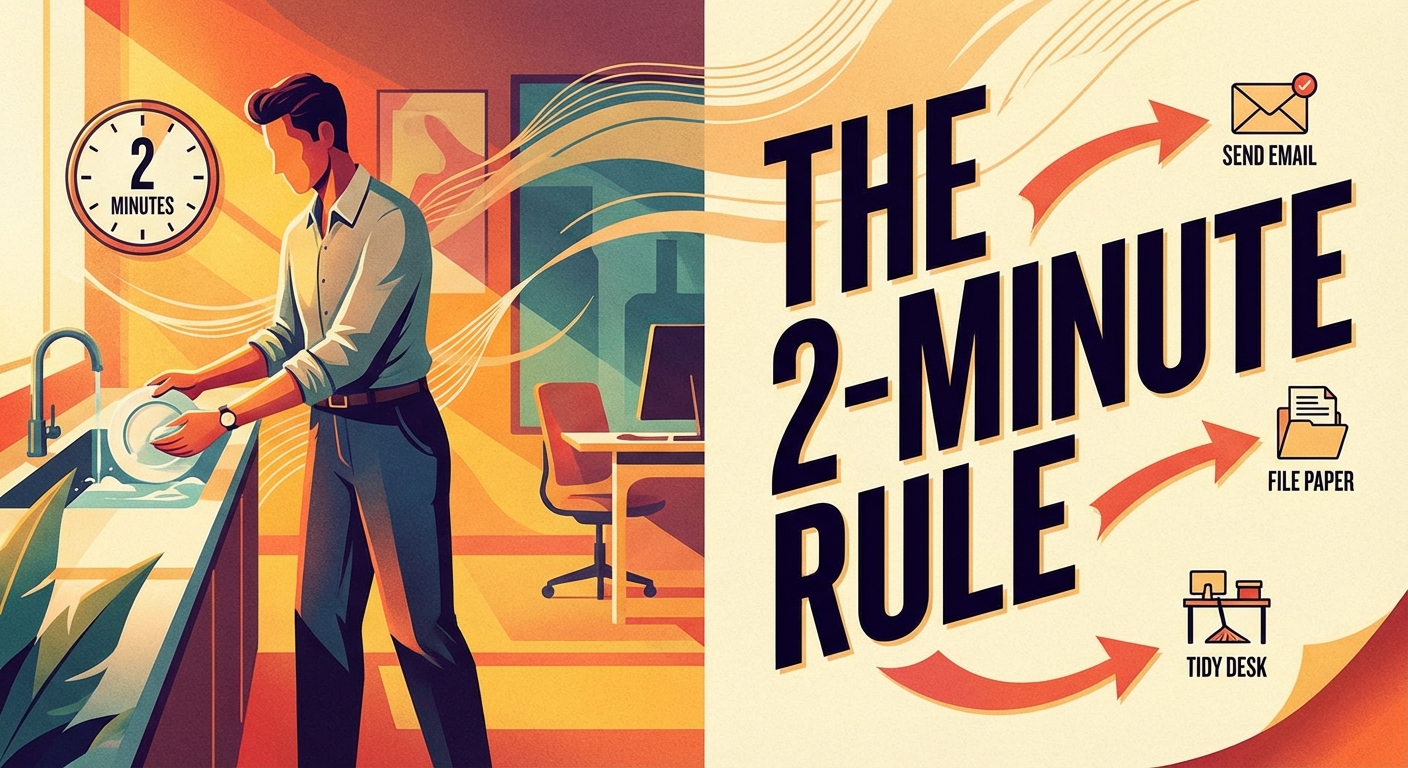
The concept comes from David Allen, the author of the productivity bible, Getting Things Done.
The rule is incredibly simple.
If a task takes less than two minutes to complete, do it immediately.
Do not write it down.
Do not put it on a to-do list.
Do not tell yourself you will do it "later."
Just do it.
Why "Later" is a Trap
The moment you decide to do something "later," you have created an administrative burden.
You have to remember to do it.
Or you have to write it down.
Then you have to read what you wrote down.
Then you have to prioritize it.
If an email takes 90 seconds to answer, but you spend 30 seconds putting it on a to-do list and 30 seconds reading it again later, you have wasted time.
More importantly, you have wasted mental energy.
The 2-Minute Rule bypasses the procrastination circuit in your brain.
It creates a bias toward action.
When I first started applying this at My Core Pick, I was skeptical.
I thought, "If I stop for every little thing, I'll never get the big things done."
I was wrong.
Here is why.
How to Apply It (Without Losing Focus)
Implementing this rule requires a bit of nuance.
You don't want to become a reactive robot, bouncing from one distraction to the next.
Here is how I use it to maintain a clean house and a clear mind.
1. The Physical Space (The "One Touch" Method)
This is where the rule shines the brightest.
When you walk in the door, hang up your coat. (10 seconds).
When you finish eating, rinse the plate and put it in the dishwasher. (45 seconds).
When you open the mail, throw the junk in the recycling immediately. (20 seconds).
If you put a dish in the sink, you are telling your brain, "I will make a decision about this later."
If you put it in the dishwasher, the loop is closed.
I realized that my "messy house" wasn't a result of not cleaning enough.
It was a result of deferring hundreds of 30-second tasks.
By doing them immediately, the mess never accumulates.
2. Digital Communication
This is the tricky one.
If you answer every email the second it arrives, you will never get any work done.
I recommend batching your communication.
I check my email three times a day.
During those blocks, I apply the 2-Minute Rule ruthlessly.
If I open an email and the reply requires a simple confirmation or a quick "Thanks," I send it right then.
I archive it. It is gone.
If it requires research or a long thoughtful response, that goes on the to-do list.
This keeps my inbox near zero.
It prevents that sinking feeling of seeing "50 Unread Messages."
3. The "Start It" Hack
There is a secondary application of the 2-Minute Rule that is pure magic for procrastination.
Sometimes the task is big.
Maybe you need to write a blog post (like this one) or go for a run.
You can't do those in two minutes.
But you can do the first two minutes.
The Rule: If you don't want to do something, tell yourself you will just do two minutes of it.
"I will just put on my running shoes and step outside."
"I will just write the opening sentence."
Usually, the hardest part of any task is starting.
Physics tells us that an object at rest stays at rest.
You need a catalyst to get moving.
Once you have your running shoes on, you might as well run.
Once you have written one sentence, the second one comes easier.
The Psychology of Momentum
Why does this work so well?
It comes down to dopamine.
Our brains love completing things.
Every time you cross a task off a list—or simply finish it—you get a tiny hit of dopamine.
It makes you feel productive.
It makes you feel capable.
When you start your day by knocking out three or four tiny 2-minute tasks, you build momentum.
You feel like a winner before 9:00 AM.
Breaking the Wall of Awful
For those of us with ADHD or just general anxiety, tasks build up what some experts call a "Wall of Awful."
A simple phone call to make a doctor's appointment can feel like climbing Everest.
We build it up in our heads.
We think about how hold music is annoying.
We worry about checking the calendar.
The 2-Minute Rule acts as a sledgehammer to that wall.
It simplifies the command.
Instead of "Figure out my medical life," the command becomes "Dial the number."
It reduces the friction.
And when you reduce friction, you increase consistency.
Pitfalls to Avoid
As much as I love this rule, there are traps.
I have fallen into them, and I want you to avoid them.
Trap 1: The Rabbit Hole
You go to clean a dish (2 minutes).
You notice the sponge is dirty.
You go to get a new sponge under the sink.
You see the cabinet is disorganized.
Suddenly, you are reorganizing the entire kitchen.
The Fix: Be strict with the time limit.
If you realize the task is growing into a 10-minute project, stop.
Add it to your to-do list and move on.
Trap 2: Productive Procrastination
This is when you do 2-minute tasks instead of your important work.
You answer quick emails for two hours to avoid writing that report.
You feel busy, but you aren't effective.
The Fix: Use the rule during transition times.
Use it between meetings.
Use it right before lunch.
Use it when you are too tired for deep work.
Do not use it during your "Power Hour" when you should be focused on your core pick of the day.
Your Challenge for Today
I don't want you to just read this and nod your head.
I want you to try it.
Right now.
Look around your immediate environment.
Is there a wrapper on the desk? Throw it away.
Is there a text you’ve been ignoring? Reply.
Is there a book on the floor? Put it on the shelf.
Find one thing that takes less than 120 seconds.
Do it.
Notice how your shoulders drop a little bit?
Notice that tiny spark of relief?
That is the feeling of a loop closing.
That is the feeling of regaining control.
Life is complicated enough.
We have big decisions to make, careers to build, and families to love.
Don't let the little things steal the energy you need for the big things.
Adopt the 2-Minute Rule.
Clear the clutter.
And get back to what truly matters.
What is the one 2-minute task you’ve been putting off all week? Let us know in the comments below!