The first time I saw my bank account after a double-taxation hit, I almost choked on my coffee.
I was living my dream life in Europe, hopping between cafes and co-working spaces.
I thought I was free.
But because I hadn’t counted my days, two different governments decided I belonged to them.
It was a costly, stressful lesson that nearly ended my digital nomad journey.
At My Core Pick, we want to make sure you never have to experience that panic.
Taxes are the unsexy side of the nomadic lifestyle, but mastering them is the key to true freedom.
Specifically, you need to understand the "183-Day Rule."
It sounds like a boring statute, but it is actually the single most important number in your life right now.
Get it right, and you keep your hard-earned cash.
Get it wrong, and you could be paying up to 50% of your income to a country you were just "passing through."
Here is your comprehensive guide to mastering the calendar and keeping your money.
What Is the 183-Day Rule? (And Why It Scares Me)

At its simplest level, the 183-day rule is a global standard used by most countries to determine tax residency.
The logic is straightforward.
If you spend more than half the year (183 days) in a country, you are effectively a resident.
Therefore, you owe them taxes on your worldwide income.
Not just the money you earned while sitting in their cafes.
Everything.
It’s Not Just About Physical Presence
Here is where it gets tricky.
Most new nomads assume that if they leave on day 182, they are safe.
I used to think that, too.
But tax laws are rarely that black and white.
While 183 days is the "hard" trigger, many countries have "soft" triggers.
These are often called "ties" or "center of vital interest."
If your spouse lives there, you might be a tax resident on day one.
If you buy a house there, the countdown might not matter.
If you send your kids to school there, the government assumes you are staying.
The "Worldwide Income" Trap
Why is becoming a tax resident so dangerous?
Because most countries tax residents on everything they earn globally.
Let's say you are an American freelancer working in Spain.
If you stay in Spain for 184 days, Spain wants to tax you.
But the US taxes based on citizenship, so they want to tax you, too.
Without proper planning, you are now paying two tax bills on the same dollar.
That is the nightmare scenario we are avoiding today.
The Common Traps That Catch Nomads Off Guard
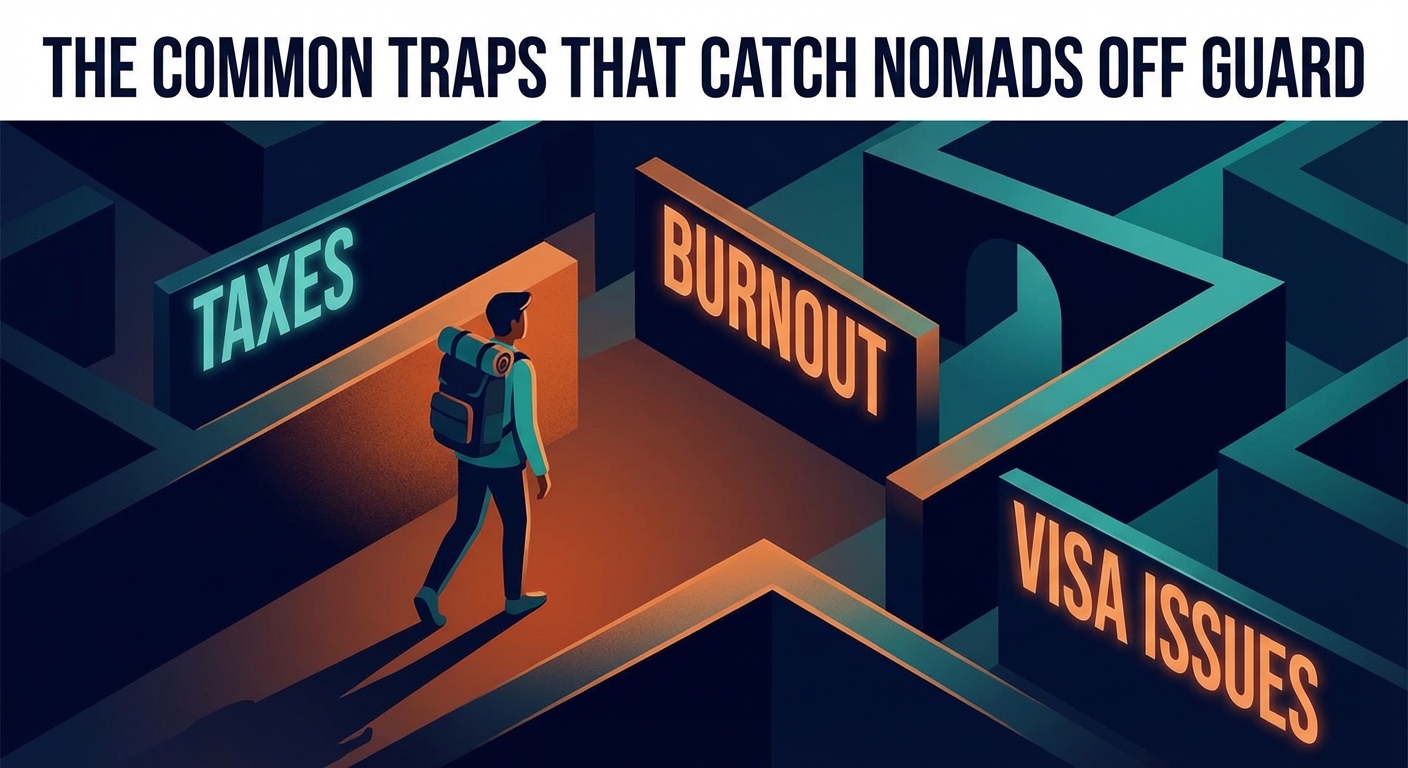
In my years of consulting with remote workers, I see the same mistakes happen over and over.
The biggest issue is treating tax law like a simple math problem.
It is much more nuanced than that.
The "Calendar Year" vs. "Rolling Year" Myth
Many nomads think the clock resets on January 1st.
For some countries, like Malaysia or Thailand, that is true.
But for others, like the UK or Australia, the tax year starts in April or July.
And then there are countries that use a "rolling 12-month period."
This means they look at any 12-month window, regardless of the calendar year.
If you arrive in November and stay until May, you might trigger residency in a rolling system.
Always check the specific definition of the "tax year" for your destination.
The "Partial Day" Count
How does a country define a "day"?
I once assumed that a travel day didn’t count.
I was wrong.
In many jurisdictions, if you are in the country at midnight, it counts as a full day.
In others, setting foot in the airport counts as a day, even if you leave three hours later.
The United States has a "Substantial Presence Test" where days from previous years carry over fractionally.
It sounds complicated because it is.
Never assume your logic matches the tax authority's logic.
The "Intent" Factor
Immigration officers and tax officers often don’t talk to each other, but sometimes they share data.
If you enter a country on a tourist visa but sign a 12-month lease, you are signaling intent.
Tax authorities look at intent.
If you join a local gym, buy a car, or get a local library card, you are building "ties."
You might not hit 183 days, but if you look like a resident, they might tax you like one.
Strategic Planning: How to Structure Your Travel

Now that we know the dangers, let’s talk about the solutions.
This isn't about evasion; it's about optimization.
You have the freedom to move, so use it to your financial advantage.
The "Perpetual Traveler" Strategy
This is the classic nomad approach.
You never spend more than 3 to 4 months in any single country.
By constantly moving, you never trigger the 183-day rule anywhere.
I did this for three years.
I would spend summer in the Balkans, autumn in Asia, and winter in South America.
Legally, I was a tourist everywhere.
However, this lifestyle is exhausting.
It also carries a new risk: being a tax resident of nowhere.
Banks and investment firms hate this.
They need to know where you live.
If you can't prove residency somewhere, they might freeze your accounts.
The "Tax Haven" Base Strategy
This is the strategy I recommend to most long-term nomads.
Pick a home base with favorable tax laws and establish legal residency there.
Places like Dubai (UAE), Panama, or territorial tax countries like Thailand or Malaysia are popular.
You get a visa, you rent an apartment, and you get a tax ID.
You spend just enough time there to maintain the residency.
For the rest of the year, you travel.
Now, when a country asks, "Where do you pay taxes?" you have an answer.
You show them your UAE tax ID.
This protects you from other countries trying to claim you.
You are paying $0 (or very little) legally, and you have the paperwork to back it up.
The "Treaty Tie-Breaker" Strategy
Sometimes, you want to spend time in high-tax countries.
Maybe you love spending summers in France or Italy.
You can leverage Double Taxation Treaties (DTTs).
These are agreements between two countries to prevent you from being taxed twice.
If you are a tax resident of the UK but spend 5 months in Spain, a treaty decides who gets to tax you.
Usually, the treaty favors the country where your "permanent home" is available.
If you keep your main home in your low-tax base, the treaty protects you from the high-tax country you are visiting.
The Art of Proof: Documenting Your Whereabouts
The burden of proof is always on you.
If a tax authority sends you a letter five years from now, can you prove where you were on June 12, 2021?
Most people can’t.
But as a professional nomad, you must be an obsessive record-keeper.
Your Digital Paper Trail
I keep a spreadsheet that tracks my location every single day.
It sounds tedious, but it takes ten seconds a day.
I color-code it by country.
At the end of the year, I know exactly how many days I spent in each jurisdiction.
There are also apps like "TaxResident" or "Ovantis" that use your phone's GPS to track this automatically.
Keep Your Receipts
Passport stamps are becoming rare.
In the EU Schengen zone, you rarely get stamped when crossing borders.
This makes it hard to prove when you left France and entered Germany.
You need secondary proof.
Save every boarding pass.
Save train tickets.
Keep credit card statements that show physical transactions (coffee, groceries) in specific locations.
These transaction logs are your best defense during an audit.
The Lease Agreement
Always keep copies of your rental agreements.
If you are using Airbnb, download the PDF receipts.
These prove where you were sleeping at night.
If you are trying not to be a resident, ensure these are short-term rentals.
If you sign a 12-month lease, you are handing the tax man a loaded gun.
What If You Accidentally Trigger the Rule?
Okay, panic time.
Maybe you broke your leg and got stuck in Germany for 7 months.
Maybe you fell in love and lost track of time.
You are now a tax resident. What happens?
Don't Ignore It
The worst thing you can do is hope they don't notice.
With the Common Reporting Standard (CRS), banks share data with governments automatically.
If you have a bank account in a country you stayed in too long, the tax authority will find out.
Utilize Foreign Tax Credits
Most countries have mechanisms to avoid double taxation, even without a treaty.
If you are an American, you have the Foreign Earned Income Exclusion (FEIE) and the Foreign Tax Credit.
These allow you to subtract taxes paid to a foreign government from your US bill.
Or, you can exclude the first ~$120,000 of your income from US taxes if you live abroad.
Other countries have similar "relief" clauses.
You declare the income, calculate the tax, and then deduct what you already paid elsewhere.
It is paperwork-heavy, but it saves you from paying 70% effective tax.
Hire a Specialist
I cannot stress this enough.
TurboTax is not going to help you here.
You need an accountant who specializes in expat and cross-border taxation.
Yes, they might cost $500 an hour.
But if they save you $20,000 in double taxes, it is the best investment you will make all year.
Final Thoughts: Freedom Requires Discipline
The digital nomad lifestyle is marketed as pure freedom.
Laptops on beaches, coconuts, and zero responsibilities.
But true freedom requires a foundation of discipline.
If you ignore the 183-day rule, you aren't free; you're just lucky.
And luck eventually runs out.
By understanding these rules, tracking your days, and picking a strategic tax home, you take control.
You stop worrying about the letter in the mail.
You stop fearing the border control agent.
You can enjoy that coffee in Paris or that beach in Bali knowing your money is safe.
Don't let the tax man ruin your adventure.
Count your days, keep your receipts, and travel smarter.
Disclaimer: I am a seasoned digital nomad and editor, not a certified tax attorney. Tax laws change frequently and vary by citizenship. Always consult with a qualified tax professional regarding your specific situation.