Stop the Spiral: How to Use the 5-4-3-2-1 Method to Ground Yourself Instantly
We’ve all been there.
One minute, you’re sitting at your desk or driving your car.
The next, your chest tightens.
Your thoughts start racing faster than you can catch them.
It starts with one worry, which leads to a "what if," which spirals into a catastrophe.
Suddenly, you feel untethered.
This is the anxiety spiral.
It feels overwhelming, scary, and sometimes impossible to stop.
But here at My Core Pick, we believe in practical tools that work in the real world.
You don’t always need a quiet room or an hour of meditation to find your center.
Sometimes, you just need a few minutes and your own five senses.
Today, we are breaking down the 5-4-3-2-1 method.
It is simple, effective, and completely invisible to the people around you.
Here is how you can stop the spiral and ground yourself instantly.
Understanding the "Spiral" and Why You Need to Ground

Before we dive into the technique, let's talk about what is happening in your body.
When anxiety hits, your brain's "alarm system" (the amygdala) takes over.
It perceives a threat, even if that threat is just a thought.
Your body prepares to fight or flee.
Adrenaline floods your system.
Your prefrontal cortex—the logical, thinking part of your brain—goes offline.
This is why you can’t simply "talk yourself out of it."
Your logic isn't in the driver's seat anymore; your survival instincts are.
The Power of Grounding
Grounding is a technique designed to bring you back to the present moment.
It pulls your focus away from the hypothetical disasters in your head.
It redirects your attention to the physical reality of your body and surroundings.
By engaging your senses, you force your brain to switch gears.
You turn the prefrontal cortex back on.
You signal to your body that you are safe, here, and now.
The 5-4-3-2-1 method is the gold standard for this.
It is systematic, easy to remember, and incredibly powerful.
Step 1: Acknowledge and Breathe
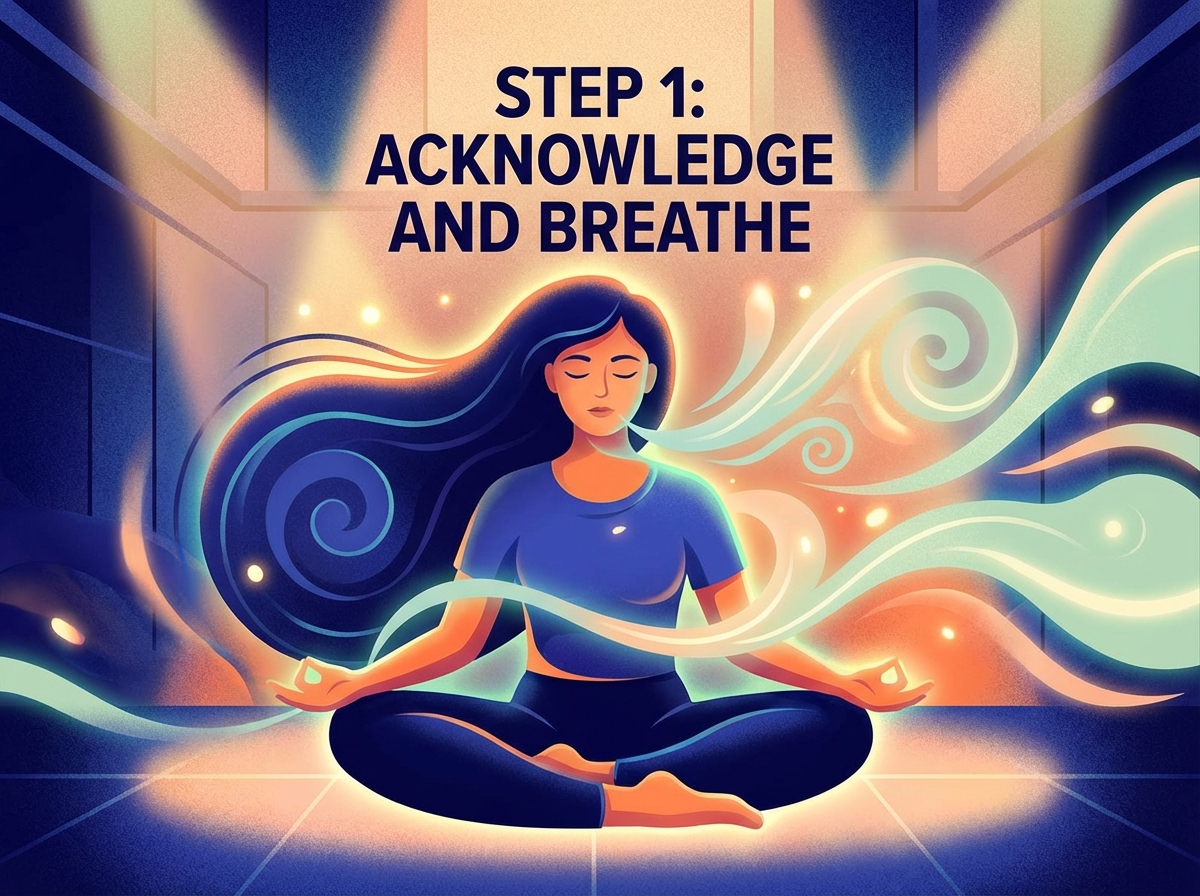
Before you start counting, take a pause.
Acknowledge that you are feeling anxious or panicked.
Don't judge yourself for it.
Just say to yourself, "I am feeling anxious right now, and that is okay."
Now, take a deep breath.
Inhale slowly through your nose for a count of four.
Hold it for a second.
Exhale slowly through your mouth.
Do this two or three times.
This signals your parasympathetic nervous system to start the calming process.
Once you have taken a breath, begin the method.
The 5-4-3-2-1 Method: A Step-by-Step Guide
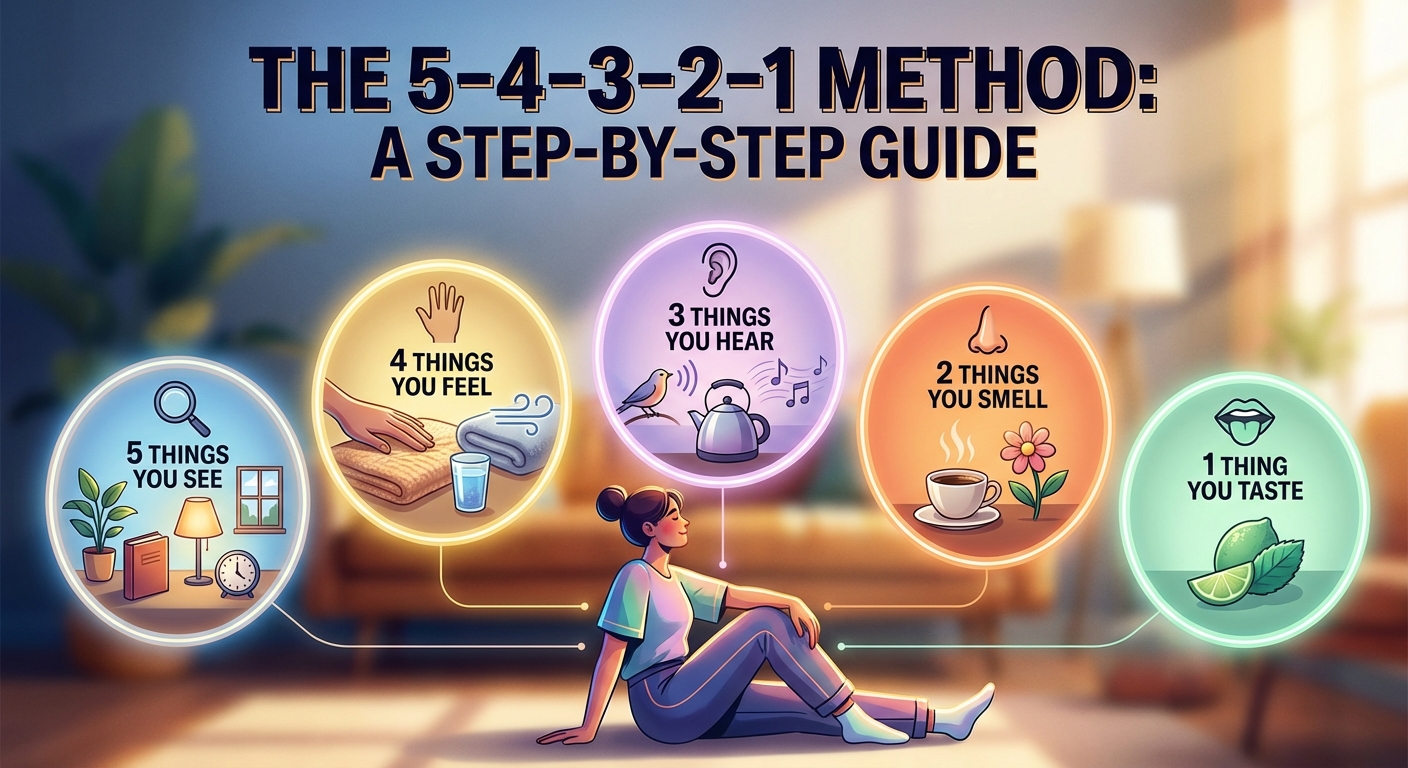
This technique moves through your five primary senses.
You don't have to speak out loud (though you can if you are alone).
You just need to focus intensely on each step.
5 Things You Can See
Look around you.
Identify five separate objects in your immediate vicinity.
Don't just glance at them.
Really see them.
Notice the details.
Maybe it’s the way the light hits your coffee mug.
Or a stray thread on the carpet.
Perhaps it’s the texture of the paint on the wall.
Look for a specific color or shape.
"I see a blue pen."
"I see a crack in the ceiling."
"I see the green leaves of a plant."
"I see my own shoes."
"I see the reflection in the window."
By forcing your eyes to focus on details, you are visual grounding.
You are telling your brain to process visual data instead of internal worries.
4 Things You Can Feel
Now, shift your attention to your sense of touch.
Find four things you can physically feel right now.
Start with your own body.
Feel the weight of your feet on the floor.
Feel the fabric of your shirt against your skin.
Is the air in the room cold or warm against your face?
Reach out and touch the arm of your chair.
Is it smooth? Rough? Cold?
Run your fingers through your hair.
"I feel the denim of my jeans."
"I feel the cold glass of water."
"I feel the tightness of my watch band."
"I feel the solid ground beneath me."
Connecting to physical sensations is one of the fastest ways to exit your head.
3 Things You Can Hear
Close your eyes if you feel comfortable doing so.
Listen carefully.
Identify three distinct sounds.
Don't settle for the obvious loud noises.
Try to hear the layers of sound in your environment.
Maybe you hear the hum of the refrigerator.
Or the sound of traffic passing outside.
Perhaps you can hear a clock ticking.
Or the sound of your own breathing.
"I hear a dog barking in the distance."
"I hear the air conditioning vent blowing."
"I hear typing on a keyboard."
Auditory focusing requires concentration.
This concentration breaks the loop of anxious thoughts.
2 Things You Can Smell
This step can be a little trickier, but give it a try.
Identify two things you can smell.
Take a deep breath in through your nose.
Maybe you smell coffee brewing.
Or the scent of your laundry detergent on your clothes.
If you are outside, maybe you smell rain or exhaust.
If you can’t smell anything distinct immediately, look for something.
Pick up a candle, a tube of lotion, or even a piece of gum.
Bring it to your nose and inhale.
"I smell the citrus in my hand sanitizer."
"I smell old paper."
Smell is directly linked to the emotional center of the brain.
A pleasant or distinct scent can be very grounding.
1 Thing You Can Taste
Finally, focus on one thing you can taste.
If you have a drink or a snack nearby, take a sip or a bite.
Really focus on the flavor.
Is it sweet? Salty? Bitter?
If you don’t have food, simply notice the taste in your mouth.
Maybe it’s the lingering taste of toothpaste.
Or pop a piece of gum or a mint into your mouth.
Focusing on flavor brings your awareness completely inside your body.
It is the final anchor in the process.
Why This Method Works (The Science Behind It)
You might be wondering, "Is this just a distraction?"
In a way, yes—but it is a strategic one.
When you are spiraling, your working memory is clogged with worry.
You literally do not have the brainpower to process reality because you are processing fear.
The 5-4-3-2-1 method imposes a "cognitive load."
It forces your brain to complete a complex task.
You cannot focus on the texture of your chair and the catastrophic "what if" at the same time.
Shifting the Blood Flow
Neuroscience suggests that anxiety activates the amygdala.
Mindful observation activates the prefrontal cortex.
By actively searching for sensory input, you shift blood flow and electrical activity.
You move from the emotional brain to the logical brain.
It essentially reboots your system.
It allows the adrenaline to dissipate because the "alarm" has been turned off.
It reminds your nervous system that there is no tiger chasing you.
You are just a person, sitting in a chair, feeling a texture.
Tips for Making It Work for You
We know that in the heat of the moment, remembering the steps can be hard.
Here are a few tips to make the 5-4-3-2-1 method more effective.
Practice When You Are Calm
Don’t wait for a panic attack to try this for the first time.
Practice it when you are feeling fine.
Do it while washing the dishes or walking the dog.
This builds neural pathways.
It makes the technique familiar.
When panic strikes, your brain will know exactly what to do.
Modify It If Needed
Struggling to find two smells?
Can't taste anything?
That is perfectly fine.
The goal isn't perfection; the goal is engagement.
If you can't smell anything, name two of your favorite smells instead.
"I love the smell of vanilla and fresh cut grass."
Imagining the sensory input works almost as well as experiencing it.
Do not let the rules stress you out more.
Combine with Movement
Sometimes, anxiety comes with a lot of physical energy.
If sitting still feels impossible, do the method while walking.
Walk slowly.
Feel your feet hit the pavement (Touch).
Look at the trees (Sight).
Listen to the birds (Sound).
Moving your body can help burn off the excess adrenaline while you ground your mind.
Making Grounding a Habit
At My Core Pick, we believe mental health is a daily practice.
The 5-4-3-2-1 method isn't just an emergency brake.
It is a way to live more mindfully.
We live in a world of constant distraction.
We are rarely truly "present."
Using this technique daily can lower your baseline stress levels.
It trains your brain to notice the world around you.
It helps you appreciate the small details.
The Cumulative Effect
The more you ground yourself, the less power the spiral has.
You start to recognize the signs of anxiety earlier.
You catch the spiral before it spins out of control.
You gain confidence in your ability to handle difficult emotions.
You realize that feelings are temporary.
And that you have the tools to navigate them.
Conclusion: You Are in Control
Anxiety lies to us.
It tells us we are helpless.
It tells us that the bad feeling will last forever.
The 5-4-3-2-1 method is your proof that anxiety is wrong.
You have the power to change your physical and mental state.
You can shift your focus.
You can return to the present moment.
So, the next time you feel your heart race or your thoughts spin, remember the countdown.
5 things you see.
4 things you feel.
3 things you hear.
2 things you smell.
1 thing you taste.
Take a deep breath.
You are here.
You are safe.
You’ve got this.