There is nothing—and I mean nothing—more frustrating than hitting a wall in the gym.
You know the feeling.
For months, you’ve been adding weight to the bar like clockwork.
Every Monday was a victory.
Then, suddenly, it stops.
The barbell feels glued to the floor.
Your bench press hasn’t budged in three weeks.
You leave the gym feeling weaker than when you walked in.
Welcome to the plateau.
It happens to every lifter, usually right after the "newbie gains" phase ends.
But here is the good news: you haven’t reached your genetic potential.
You just need a new strategy.
At My Core Pick, we believe in training smarter, not just harder.
Today, I’m going to walk you through the Double Progression Model.
It is the single most effective way to guarantee continuous strength gains for intermediate lifters.
Let’s get that bar moving again.
Why Linear Progression Eventually Fails

To understand the solution, we first have to understand the problem.
When you first started lifting, you likely used Linear Progression.
This is the standard "add 5 pounds every workout" method.
It works like magic for the first six to twelve months.
Your nervous system is adapting rapidly.
Your technique is improving.
But eventually, the math catches up with you.
If you added 5 pounds to your bench press every week for two years, you’d be benching over 500 pounds.
We know that isn’t realistic.
The Recovery Trap
As you get stronger, the stress you place on your body increases.
Lifting 200 pounds taxes your central nervous system much more than lifting 100 pounds.
Eventually, you cannot recover fast enough to add weight every single session.
If you try to force it, two things happen.
First, your form breaks down.
Second, you risk injury or burnout.
This is where the plateau happens.
You are trying to force a linear square into a non-linear circle.
You need a method that allows for adaptation before increasing the load.
That is where Double Progression comes in to save the day.
What is the Double Progression Model?

Most people only focus on one form of progressive overload: weight.
They think the only way to progress is to make the bar heavier.
That is Single Progression.
Double Progression manipulates two variables instead of just one.
- Variable One: Volume (The number of repetitions).
- Variable Two: Intensity (The weight on the bar).
By toggling these two levers, you give your body two different ways to get stronger.
You don't earn the right to add weight until you have mastered the volume.
The Philosophy of Mastery
Think of Double Progression as a test.
With linear progression, you are guessing that you are stronger than last week.
With Double Progression, you have to prove it.
You must hit a specific number of reps across all your sets before you are allowed to touch the weight stack.
It changes your focus.
You stop obsessing over the number on the plates.
Instead, you start obsessing over the quality and quantity of your reps.
This shift in mindset is often enough to break a plateau all on its own.
How to Implement Double Progression (Step-by-Step)
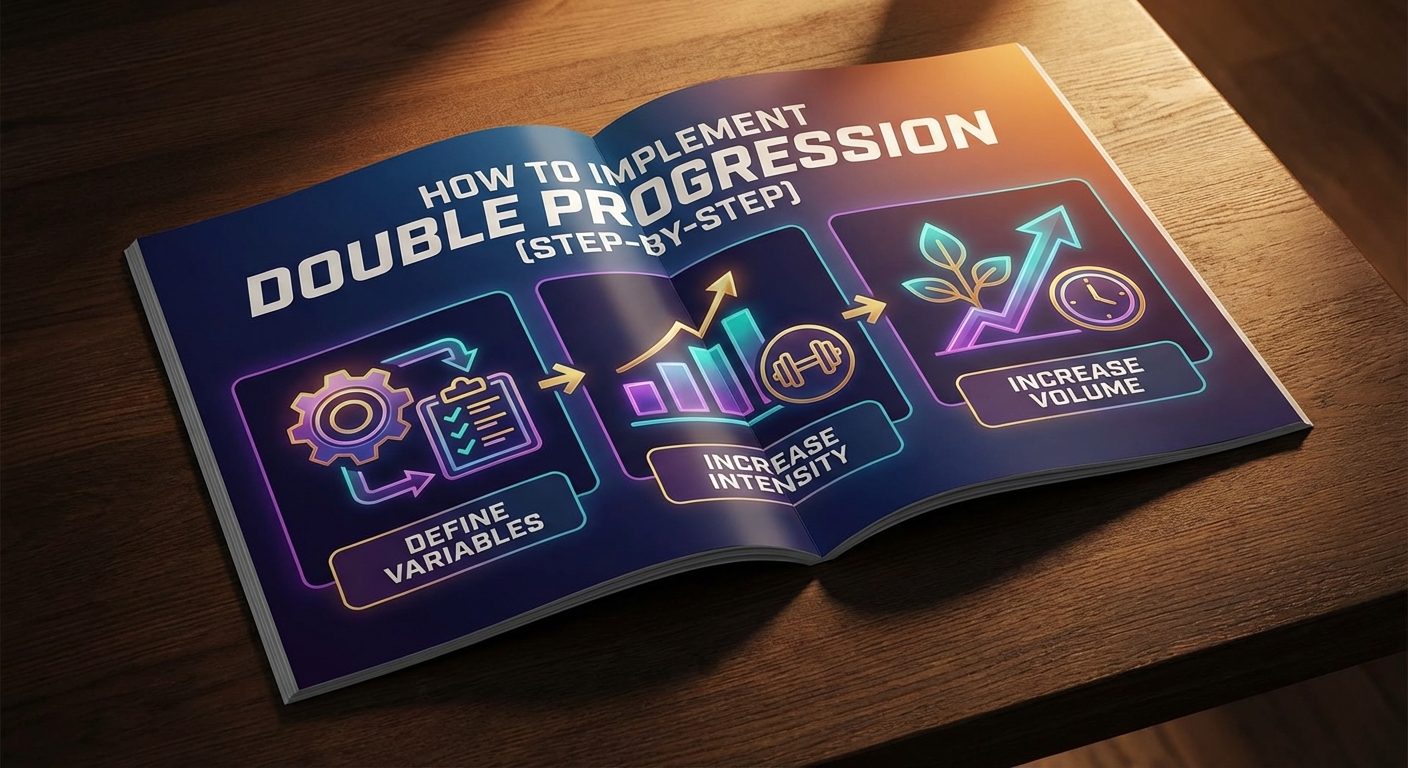
So, how do we actually do this?
It is surprisingly simple, but you have to be disciplined.
You need a logbook or a tracking app.
Do not try to remember this in your head.
You need data.
Step 1: Establish Your Rep Range
Forget doing "3 sets of 10."
Fixed rep schemes are the enemy of Double Progression.
Instead, you are going to pick a Rep Range.
For compound lifts (Squats, Bench, Overhead Press), I recommend 6 to 8 reps or 8 to 10 reps.
For isolation movements (Curls, Lateral Raises, Tricep Extensions), I recommend 10 to 12 reps or 12 to 15 reps.
Let’s say we choose 8–12 reps for a Dumbbell Shoulder Press.
Step 2: The "Floor" and the "Ceiling"
The bottom of your range (8 reps) is your Floor.
The top of your range (12 reps) is your Ceiling.
You pick a weight that you can lift for at least the Floor number (8), but not quite the Ceiling (12).
Let's say you grab the 40lb dumbbells.
Step 3: The Progression Rule
Here is the golden rule.
You keep the weight the same (40lbs) until you can hit the Ceiling (12 reps) for every single set.
If you are doing 3 sets, you need to hit 12, 12, and 12.
Only then do you increase the weight.
A Real-World Example
Let's look at what this looks like over a month of training.
Week 1:
You lift 40lbs.
Set 1: 12 reps (Easy)
Set 2: 10 reps (Getting tired)
Set 3: 8 reps (Failure)
Result: You did not hit 12 reps on all sets. Keep the weight.
Week 2:
You stick with 40lbs. You fight for more reps.
Set 1: 12 reps
Set 2: 11 reps
Set 3: 9 reps
Result: Improved volume, but not mastered. Keep the weight.
Week 3:
Still at 40lbs.
Set 1: 12 reps
Set 2: 12 reps
Set 3: 11 reps
Result: So close! But you missed the last rep. Keep the weight.
Week 4:
40lbs. You are determined.
Set 1: 12 reps
Set 2: 12 reps
Set 3: 12 reps
Result: MASTERY. You have graduated.
Week 5:
Now, you grab the 45lb dumbbells.
Your reps will drop back down toward the Floor (maybe 10, 9, 8).
The process starts over.
Why This Method Guarantees Strength
You might look at that example and think, "Wait, I didn't increase the weight for a whole month?"
Exactly.
But were you stagnant?
No.
Look at Week 2 and Week 3.
You performed more total reps than the week before.
That is progressive overload.
You were increasing the total volume lifted.
Building Muscle to Build Strength
By forcing yourself to work in the higher rep range before adding weight, you are driving hypertrophy (muscle growth).
A bigger muscle has the potential to be a stronger muscle.
When you finally add weight, you aren't just relying on neural efficiency.
You have actually built more muscle tissue to handle the load.
Autoregulation
This method also naturally adjusts to your energy levels.
Having a bad day?
Maybe you only get 9 reps instead of 11.
That’s fine. You stay at that weight.
You don't get crushed by a heavy barbell you weren't ready for.
It keeps you safe, and it keeps your ego in check.
Common Mistakes to Avoid
While this model is simple, people still mess it up.
Usually, it comes down to impatience.
Here are the pitfalls I see most often at My Core Pick.
Mistake 1: Leaving Reps in the Tank
To make this work, you have to push near failure.
If you stop at 12 reps, but you could have done 15, you aren't stimulating growth.
The "Ceiling" number should be a struggle to hit.
It should be a grind.
If the Ceiling is easy, the weight is too light to begin with.
Mistake 2: Sacrificing Form for Reps
This is the classic ego trap.
You are stuck at 11 reps on your last set.
You want that 12th rep so badly so you can move up in weight next week.
So, you arch your back, swing your hips, and cheat the rep up.
Does that count?
No.
If the form breaks down, the rep does not count towards your progression.
Be honest with yourself.
If you cheat the progression, you will get crushed when you increase the weight.
Mistake 3: Jumping Weight Too Aggressively
When you finally hit your 3 sets of 12, celebrate!
But when you increase the weight, make it the smallest jump possible.
Go up by 5lbs (or 2.5lbs if you have micro-plates).
Do not jump 10 or 20lbs just because you feel strong.
The goal is to restart the cycle near the bottom of the rep range, not to crush yourself instantly.
Who Should Use Double Progression?
Is this for everyone?
Mostly, yes.
If you are a complete beginner (less than 6 months of training), stick to Linear Progression.
You can add weight every session, so you should.
Don't slow down your progress if you don't have to.
However, if you are an intermediate or advanced lifter, this is your bread and butter.
It works exceptionally well for:
- Isolation exercises: It is very hard to add 5lbs to a bicep curl every week. Double progression allows for smaller incremental gains.
- Dumbbell movements: Since dumbbell jumps are usually 5lbs (which is actually 10lbs total), bridging that gap with reps is essential.
- Overhead pressing: The shoulders are small muscles. They stall quickly on linear plans. They thrive on double progression.
The Bottom Line
Hitting a plateau doesn't mean you are done getting stronger.
It just means the "easy gains" are gone.
Now you have to work for them.
The Double Progression Model turns training into a game.
You are constantly chasing one more rep.
It rewards patience.
It rewards consistency.
And most importantly, it ensures that when you do put more weight on the bar, you truly own it.
So, next time you walk into the gym, check your ego at the door.
Pick a rep range.
Fill that bucket with reps.
Then, and only then, earn the right to go heavier.
Trust the process, and the strength will follow.