Here is the blog post, written to your specifications.
Beyond the Hype: What the Next Decade of AI Actually Looks Like
If you open your news feed right now, it feels like we are living in a sci-fi movie.
Every day, a new model drops.
One day, AI is writing Shakespeare. The next, experts warn it might end civilization.
It is exhausting, isn't it?
At My Core Pick, we spend a lot of time sifting through the noise to find the tools that actually matter.
But today, I want to take a step back.
I want to look past the viral headlines and the flashy demos.
Let’s talk about reality.
Let’s talk about what the next ten years actually look like for you, me, and the economy.
Spoiler alert: It is less about "robots taking over" and more about the internet finally growing up.
Here is my realistic forecast for the next decade of artificial intelligence.
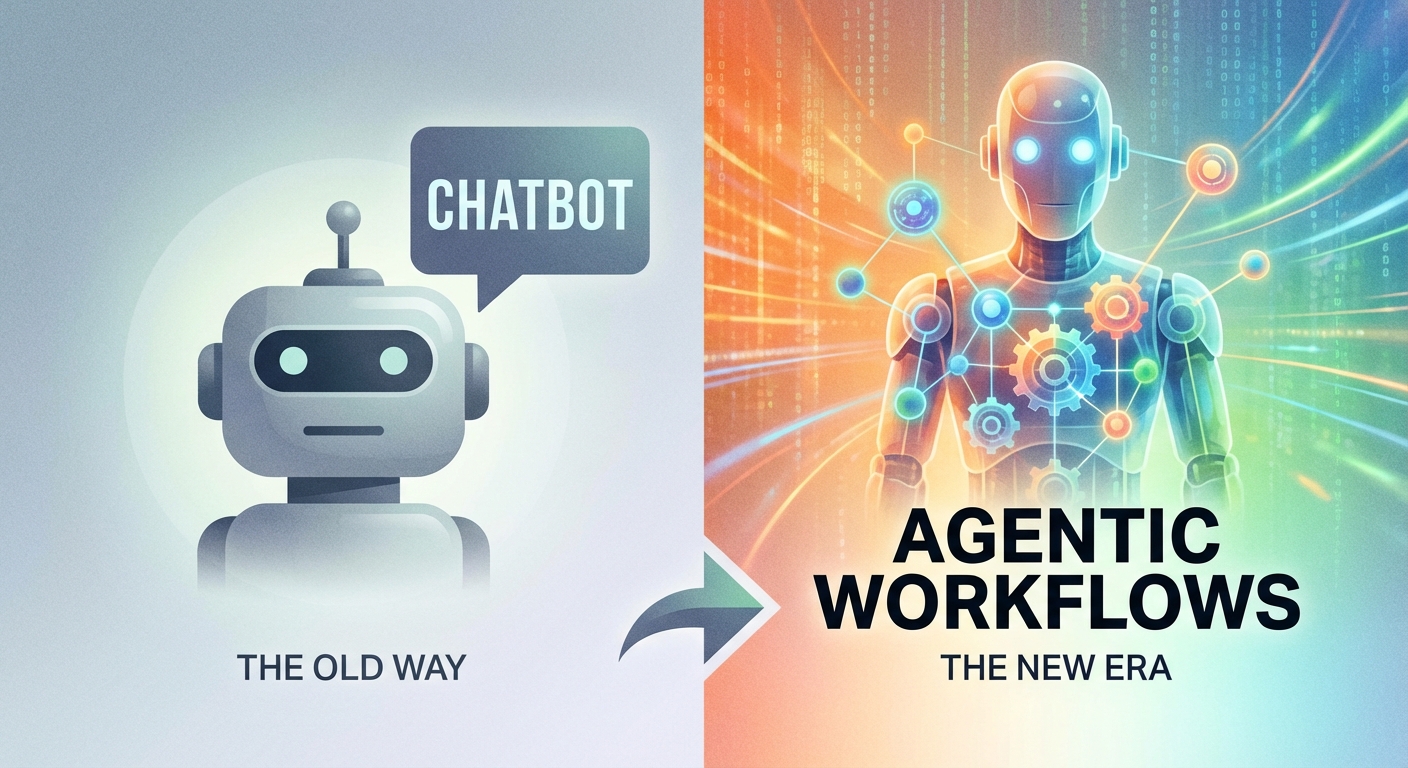
1. The Shift from "Chatbots" to "Agentic" Workflows
Right now, most of us use AI in a very specific way.
We type a prompt into a box.
The AI spits out text or an image.
We review it, edit it, and move on.
This is the "Chatbot Era."
It is impressive, but it is also passive. It requires you to drive the bus.
Over the next decade, this is going to change fundamentally.
We are moving toward Agentic AI.
Agents Do, They Don’t Just Talk
Imagine telling your computer, "Plan a trip to Tokyo for under $3,000 in May."
Right now, ChatGPT gives you an itinerary.
But you still have to go to Expedia, book the flights, find the hotels, and check your calendar.
An AI Agent will actually do it.
It will access your calendar.
It will negotiate with booking APIs.
It will use your credit card (with permission) to secure the reservations.
It will come back to you only when it needs a final "thumbs up."
The Multi-Step Revolution
We are already seeing early glimpses of this.
In the next few years, AI won’t just generate code; it will deploy it.
It won’t just write an email; it will send it and track the reply.
For businesses, this means the end of repetitive administrative loops.
For you, it means having a genuine executive assistant in your pocket.
The friction between "idea" and "execution" is about to vanish.
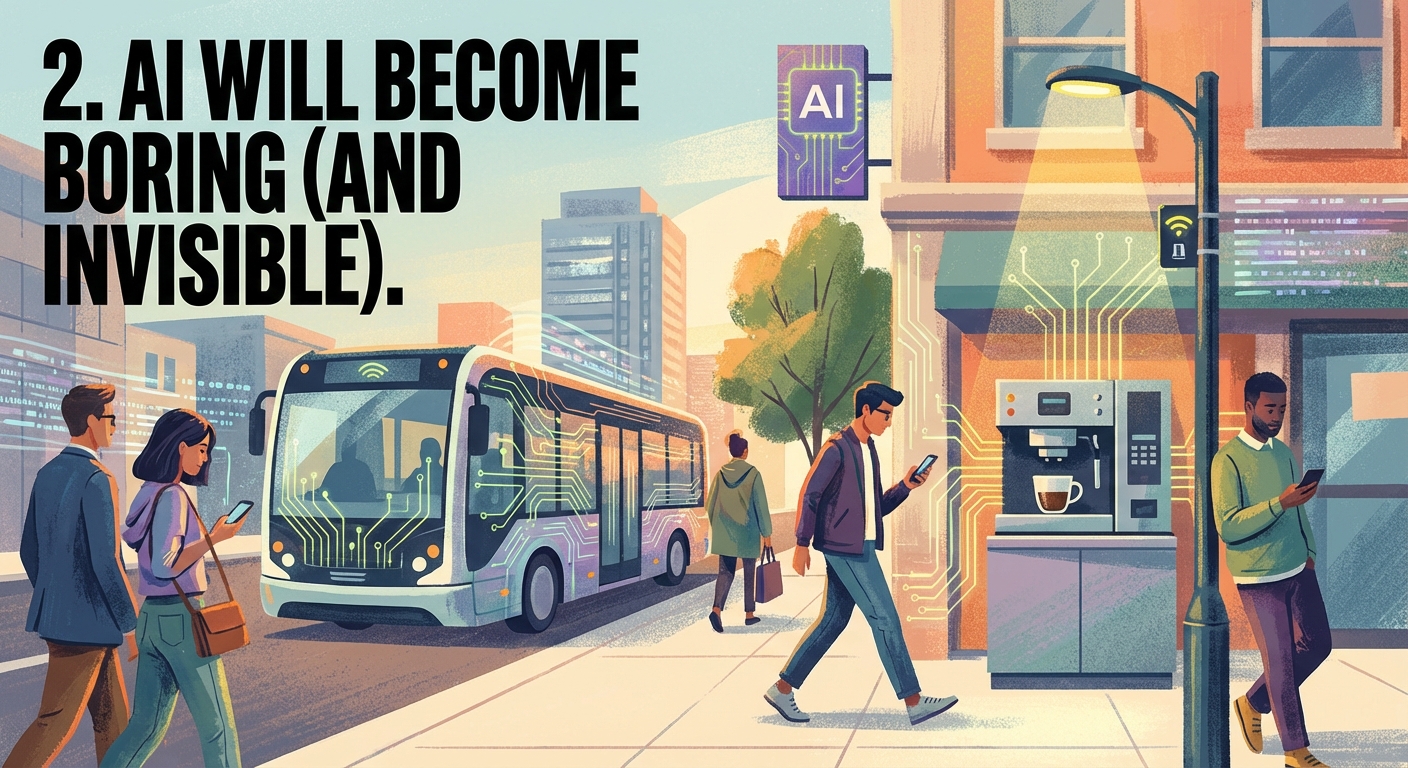
2. AI Will Become Boring (and Invisible)
This might sound counterintuitive.
Usually, when technology advances, it gets flashier.
But the most successful technologies are the ones that disappear.
Think about electricity.
You don’t walk into a room and marvel that the lights turn on. You just flip the switch.
You don’t think about "using the internet" when you stream a movie. You just watch TV.
AI is currently a novelty.
By 2030, it will be utility.
The Operating System Integration
We are about to see AI baked into the foundation of our devices.
It won’t be an app you open.
It will be the layer that connects everything on your phone.
Your calendar will talk to your maps. Your maps will talk to your email.
Your phone will know you are running late for a meeting before you do.
It will draft a text to your boss letting them know, and ask you to approve it while you drive.
No More "AI Features"
Marketing leads are obsessed with slapping "Now with AI!" on every product.
That is going to stop.
Why? Because everything will have it.
A spreadsheet that doesn't analyze itself will feel broken.
A word processor that doesn't suggest edits will feel ancient.
We will stop calling it "Artificial Intelligence."
We will just call it "computing."
The hype will die down because the utility will be everywhere.
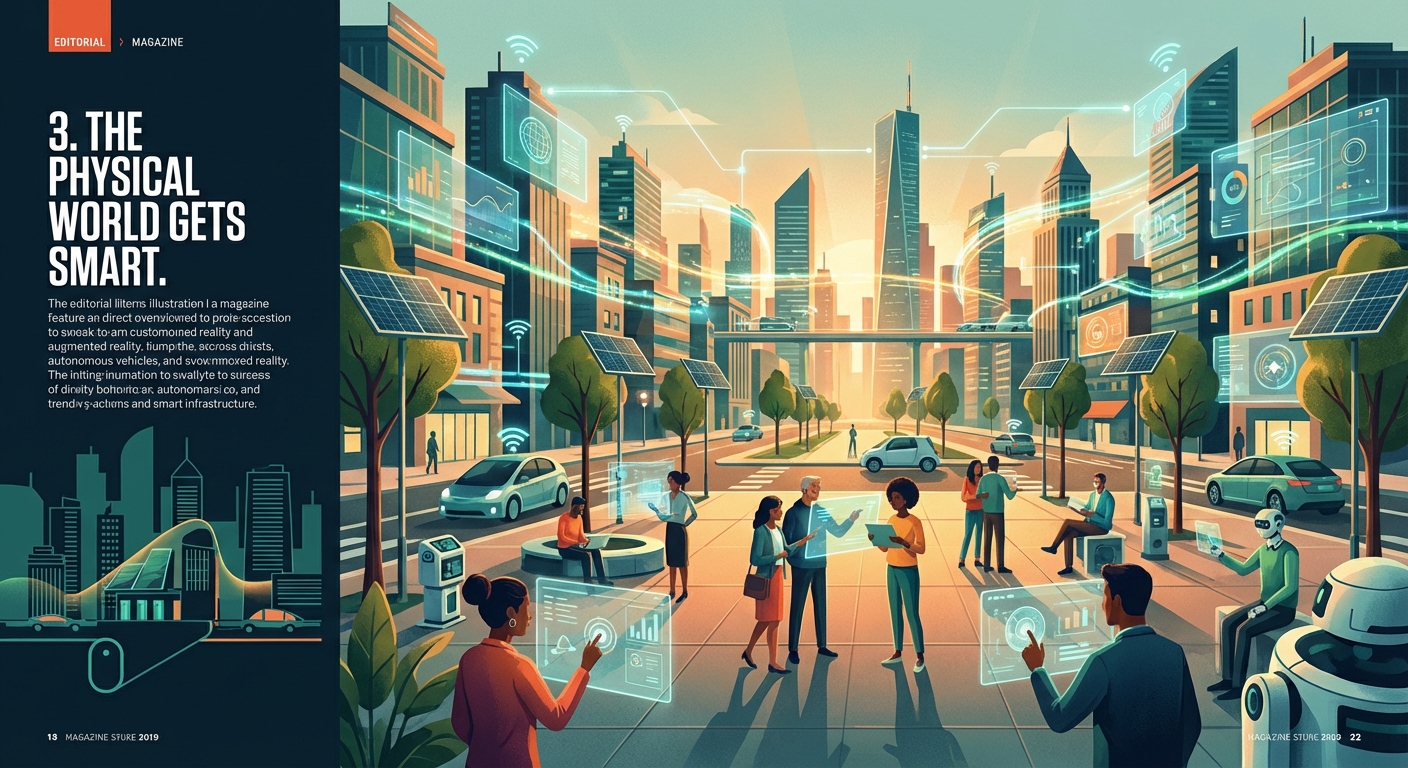
3. The Physical World Gets Smart
So far, the AI revolution has mostly lived on screens.
It creates text, images, and videos.
But the next decade is about AI stepping out of the screen and into the physical world.
This is where things get really interesting.
The Edge Computing Boom
Right now, when you ask Siri or Alexa a question, that data goes to a massive server farm, gets processed, and comes back.
That is slow and energy-intensive.
The next generation of hardware will run AI locally.
We call this "Edge AI."
Your smart glasses, your watch, and even your refrigerator will have powerful chips built-in.
They will process visual data in milliseconds without needing an internet connection.
This reduces latency to zero.
Robotics That Actually Help
I’m not talking about humanoid robots walking your dog (yet).
I’m talking about specific, functional robotics.
Warehouses are already automating, but that technology will trickle down to small businesses and homes.
Imagine a kitchen specifically designed with robotic elements to handle cleanup.
Imagine construction sites where drones monitor safety hazards in real-time.
When AI can "see" and "understand" physics, it becomes infinitely more useful.
Self-driving technology has stalled a bit, but the underlying computer vision is getting better every day.
We will likely see autonomous trucking and logistics master the highways long before robotaxis take over the suburbs.
4. Hyper-Personalization in Health and Education
If I had to pick the "Core Pick" for humanity, it would be this section.
This is where AI goes from "cool" to "life-saving."
Our current systems for health and education are based on averages.
We teach to the average student. We prescribe drugs based on the average patient.
AI destroys the average.
The Era of Precision Medicine
In the next decade, your doctor won’t just look at your symptoms.
They will run your history through an AI model trained on millions of cases.
But they will also cross-reference it with your specific genetic makeup.
AI will help design treatment plans that are unique to your biology.
We are already seeing AI detect early-stage cancers in X-rays that human doctors miss.
By 2030, continuous health monitoring via wearables will predict heart attacks days before they happen.
The shift from "reactive sick care" to "proactive healthcare" will finally be possible.
The Tutor in Your Pocket
Education is currently facing a crisis.
Teachers are overworked, and students learn at different speeds.
AI tutors are the solution.
I don’t mean a program that gives you the answers.
I mean an adaptive interface that understands how you learn.
If a student struggles with algebra, the AI will realize they respond better to visual metaphors.
It will instantly generate a graph or a video to explain the concept.
It creates a curriculum of one.
This doesn't replace teachers.
It frees them from grading and rote memorization so they can focus on mentorship and critical thinking.
5. The Elephant in the Room: Jobs and Trust
I cannot write a "Beyond the Hype" post without addressing the fear.
Will AI take jobs?
Yes.
But it will also create them.
The transition, however, will be bumpy.
The "Squeeze" of the Middle
Historically, automation hurt blue-collar jobs.
This wave is different. It targets white-collar tasks.
Data entry, basic copywriting, translation, and low-level coding are at risk.
But here is what I believe will happen:
We are going to see a massive shift toward curation and strategy.
The value of "creating" the thing will go down.
The value of "choosing" the right thing will go up.
Judgment, empathy, and creative direction will become the most expensive skills in the market.
The Crisis of Truth
The darker side of the next decade is the "Deepfake" problem.
As video generation becomes perfect, we won’t be able to trust our eyes.
This will lead to a chaotic few years.
But eventually, it will lead to a new layer of the internet: The Trust Layer.
We will likely see digital watermarking and blockchain verification become standard for news and media.
Authenticity will become a premium product.
If a human actually wrote it, filmed it, or made it, that will carry a badge of honor.
We crave human connection. AI can simulate it, but it cannot replicate it.
The Final Verdict
The next decade isn't about the Terminator.
It is about integration.
It is about moving from "Wow, look at this magic trick" to "How did I ever live without this tool?"
At My Core Pick, we believe the future belongs to the curious.
Those who learn to wield these agents will find themselves with superpowers.
Those who ignore them will fight an uphill battle.
The hype is loud.
But the reality—the quiet, steady integration of intelligence into our daily lives—is much more exciting.
Stay curious.
And keep experimenting.
What do you think is the most realistic change coming in the next 10 years? Let me know in the comments below!