Let’s be honest for a second.
Investing can feel incredibly overwhelming.
You open up your brokerage app, and it looks like the cockpit of a fighter jet.
There are flashing red and green numbers everywhere.
Charts are zigzagging with no apparent rhyme or reason.
And then there are the "gurus" on social media screaming about the next crypto coin or penny stock that’s going to the moon.
It’s exhausting.
But here at My Core Pick, we believe wealth building shouldn’t raise your blood pressure.
In fact, the most effective strategy is often the most boring one.
We call it the "Set It and Forget It" method.
It doesn’t require a degree in finance.
It doesn’t require checking your phone every five minutes.
And it certainly doesn’t require luck.
All it requires is the S&P 500, a little bit of patience, and the discipline to do absolutely nothing.
Here is your complete guide to building serious wealth on autopilot.
The S&P 500: Your Ticket to Owning the Economy

Before we dive into the "how," we need to understand the "what."
You hear the term "S&P 500" tossed around on the news every night.
But what are you actually buying when you invest in it?
Simply put, you are buying a slice of the 500 leading publicly traded companies in the United States.
We are talking about Apple, Microsoft, Amazon, Google, and Berkshire Hathaway.
But you’re also buying Johnson & Johnson, Visa, and Procter & Gamble.
The Ultimate Self-Correcting Mechanism
Here is the genius of the S&P 500.
It is a self-cleansing index.
Companies are not permanent members.
To stay in the S&P 500, a company has to remain massive and profitable.
If a company starts to fail or shrink, it gets kicked out of the index.
It gets replaced by a newer, faster-growing company.
Think about that for a moment.
You don’t have to research which companies are dying and which are rising.
The index does that for you automatically.
It ruthlessly culls the weak and adds the strong.
By investing in the S&P 500, you are essentially betting on the American economy winning over the long haul.
And historically?
That has been a very, very good bet.
Why "Set It and Forget It" Beats Timing the Market
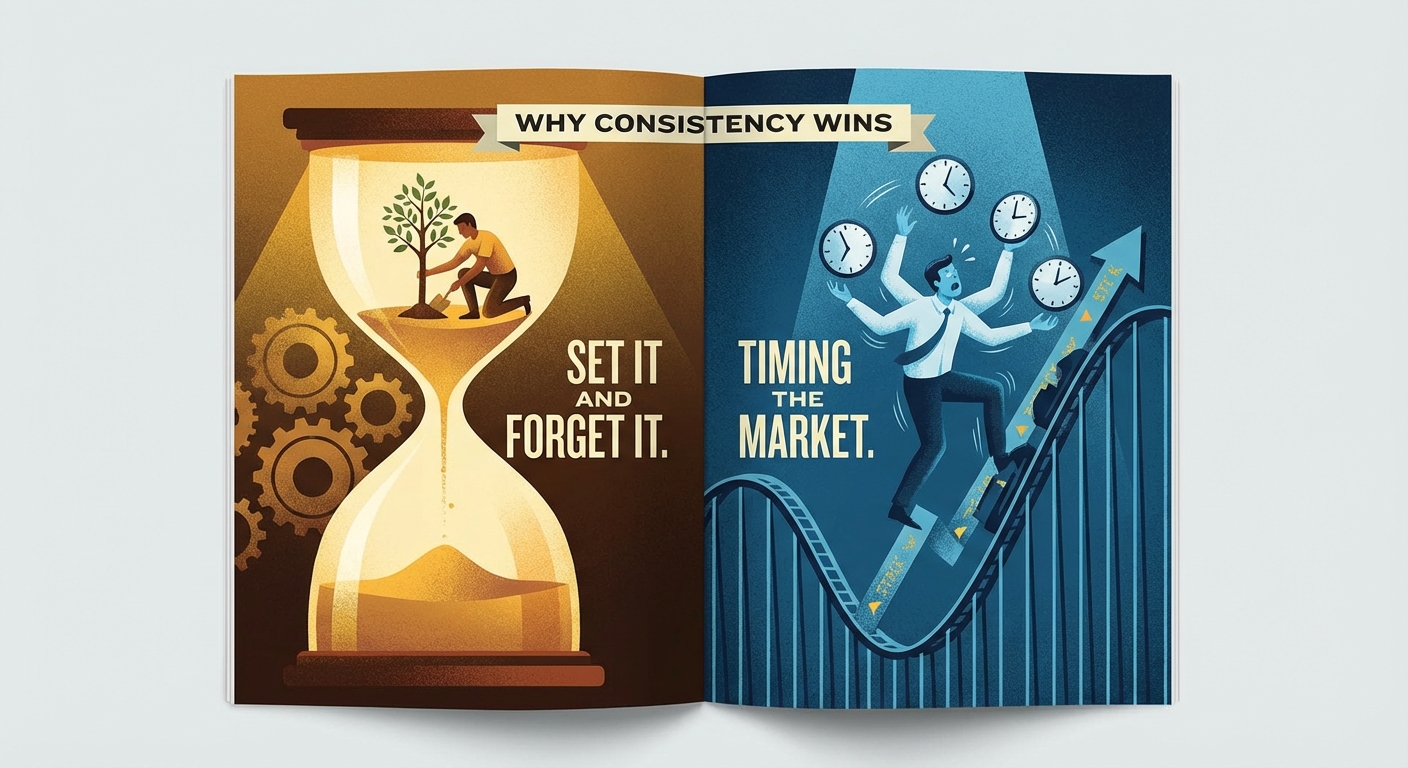
We all have that friend who thinks they can outsmart the market.
They buy high-risk stocks hoping for a quick double-up.
They sell everything when they see a scary headline on the news.
And usually, they end up losing money.
The "Set It and Forget It" philosophy removes the biggest risk to your portfolio: You.
Human emotions are terrible for investing.
Fear makes us sell at the bottom.
Greed makes us buy at the top.
By setting up a passive strategy, you remove your emotions from the equation.
The Power of Dollar-Cost Averaging
This is the engine that drives this strategy.
Dollar-Cost Averaging (DCA) is a fancy term for a simple concept.
It means investing the same amount of money at regular intervals, regardless of the price.
For example, you invest $500 on the 1st of every month.
When the market is up, your $500 buys fewer shares.
When the market is down, your $500 buys more shares.
You are automatically buying more when stocks are "on sale."
You don’t have to guess when the bottom is.
You just keep buying.
Over 10, 20, or 30 years, this consistency creates an average price that is usually very favorable.
The Eighth Wonder of the World
Albert Einstein reportedly called compound interest the eighth wonder of the world.
He said, "He who understands it, earns it... he who doesn't... pays it."
With the S&P 500, you are harnessing compounding in its purest form.
Let’s look at the historical math.
The S&P 500 has returned an average of about 10% annually over the last century.
Let’s say you invest $500 a month.
In 10 years, assuming a 10% return, you’d have roughly $100,000.
That’s nice, but it’s not life-changing yet.
But keep going.
In 20 years, you’d have roughly $380,000.
In 30 years? You’d have nearly $1,000,000.
And in 40 years?
You are looking at over $2.6 million.
You only put in $240,000 of your own money over those 40 years.
The rest—over $2 million—is pure growth.
That is the magic of setting it and forgetting it.
How to execute the Strategy (Step-by-Step)

Okay, you are sold on the concept.
Now, how do you actually press the buttons?
The good news is that we live in the golden age of the retail investor.
Barriers to entry are almost non-existent.
Here is how I would set this up today.
1. Open a Brokerage Account
You need a vessel for your wealth.
If you have a 401(k) with a match at work, start there. That is free money.
If you’ve maxed that out, or don’t have one, open an IRA (Individual Retirement Account) or a standard taxable brokerage account.
Fidelity, Vanguard, and Schwab are the titans of the industry.
They are safe, reliable, and generally offer low (or zero) fees.
There are also newer apps like Robinhood or M1 Finance that offer great user experiences.
Pick one that feels right for you.
2. Choose Your Vehicle (ETF or Index Fund)
You don’t buy the "S&P 500" directly.
You buy a fund that tracks it.
You want a fund with a very low "Expense Ratio."
This is the fee the fund charges to manage the money.
For S&P 500 funds, this should be incredibly low (around 0.03%).
Three of the most popular ETFs (Exchange Traded Funds) are:
- VOO (Vanguard S&P 500 ETF)
- IVV (iShares Core S&P 500 ETF)
- SPY (SPDR S&P 500 ETF Trust)
You really can't go wrong with VOO or IVV due to their low costs.
They all do the exact same thing: hold the 500 stocks.
Pick one ticker symbol and stick with it.
3. Automate Everything
This is the most critical step.
Do not rely on your memory to transfer money every month.
Do not rely on your willpower to buy shares when the market looks scary.
Set up an automatic transfer from your checking account to your brokerage account.
Ideally, set it for the day after payday.
Most modern platforms allow you to "Auto-Invest."
This means the money lands in the account and automatically buys shares of your chosen ETF.
You don't even have to log in.
Once this is set up, you are officially a passive investor.
The Hardest Part: Doing Nothing
I need to be real with you for a moment.
The "Set It and Forget It" strategy sounds easy on paper.
In practice, it can be psychologically difficult.
Why?
Because the market does not go up in a straight line.
There will be years where the market drops 20%.
There will be recessions.
There will be headlines screaming that "The Stock Market is Dead."
Your portfolio value will drop.
You will see thousands of dollars "vanish" on paper.
Fight the Urge to Tinker
When this happens, your instinct will be to "stop the bleeding."
You will want to sell.
You will want to wait until things "stabilize."
Do not do this.
Selling during a downturn is the only way you actually lose money.
If you sell, you lock in your losses.
More importantly, you miss the recovery.
And the recovery is usually swift and violent.
If you miss just the 10 best days of the market over a 20-year period, your returns get cut in half.
You have to trust the process.
Turn Off the News
The financial news media is not your friend.
Their goal is not to make you wealthy.
Their goal is to keep you glued to the screen so they can sell ads.
Fear sells better than optimism.
"S&P 500 Slowly Compounds Wealth Over 30 Years" is a boring headline.
"Market Crash Imminent!" gets clicks.
If you are a "Set It and Forget It" investor, the news is irrelevant to you.
Ignore the noise.
Focus on your long-term horizon.
Is This Strategy Right for You?
We love this strategy at My Core Pick, but it isn't for everyone.
It requires a specific mindset.
It is for the person who thinks in decades, not days.
It is for the person who values their time and doesn't want to spend hours analyzing balance sheets.
It is for the person who wants to sleep well at night.
Who is this NOT for?
If you are looking to get rich quick, this is not for you.
If you need this money in less than 5 years (for a house down payment, for example), the stock market is too volatile.
Keep short-term money in a High-Yield Savings Account.
But if you are building a nest egg for 10, 20, or 30 years down the road?
There is simply no better vehicle for the average person.
The Bottom Line
Building wealth doesn't have to be complicated.
It doesn't have to be stressful.
It just has to be consistent.
The S&P 500 has survived wars, depressions, pandemics, and inflation.
And through it all, it has marched upward.
By setting it and forgetting it, you are aligning your financial future with the most powerful economic engine in the world.
So, here is my challenge to you.
Log into your bank account today.
Set up that automatic transfer.
Pick your fund.
And then go enjoy your life.
Your future self will thank you.